1,830 posters, 67 videos, 75 audios, 29 topics, 22 sessions, 4,727 authors, 1,697 institutions
ePostersLive by SciGen Technologies S.A. All rights reserved.
RCOG World Congress 2023
June 12 - 14, 2023 | London, UK

EP.1361
Renal Abscess in Pregnancy
Poster Presenter
Authors
Amna Mohamed, Aamna Ai, Lucy De Lloyd, Pina Amin, Adam Naskretski, Krishna Narahari
Affiliations
Part of Topic
Maternal Medicine
Title: Renal Abscess in Pregnancy: the importance of a multidisciplinary team (MDT)
Authors:
Corresponding Author: Dr Amna Mohamed.
Authors: Dr Aamna Ali, Dr Lucy DeLloyd, Miss Pina Amin, Mr Krishna Narahari & Dr Adam Naskretski.
Objective:
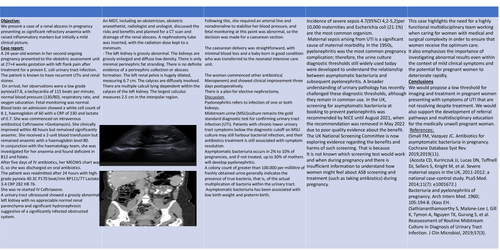
We present a case of a renal abscess in pregnancy presenting as significant refractory anaemia with raised inflammatory markers but initially a mild clinical picture.
Case report:
A 24-year-old woman in her second ongoing pregnancy presented to the obstetric assessment unit at 27+4 weeks gestation with left flank pain after treatment for a proven E. coli urinary tract infection. The patient is known to have recurrent UTIs and renal stones.
On arrival, her observations were a low grade pyrexia37.8, a tachycardia of 115 beats per minute, normal blood pressure (130/80), respiratory rate, and oxygen saturation. Fetal monitoring was normal.
Blood tests on admission showed a white cell count of 8.1, haemoglobin of 60 with a CRP of 230 and lactate of 0.7. She was commenced on intravenous antibiotics( Ceftriaxone +Gentamycin). She clinically improved within 48 hours but remained significantly anaemic. She received a 2-unit blood transfusion but remained anaemic with a haemoglobin level 80.
In conjunction with the haematology team, she was investigated for her anaemia and found deficient in B12 and folate.
After five days of IV antibiotics, her MEOWS chart was 0, so she was discharged on oral antibiotics.
The patient was readmitted after 24 hours with high-grade pyrexia 40.3C P170 beat/min BP111/77 Lactate 3.4 CRP 282 HB 76.
She was re-started IV Ceftriaxone.
A urinary tract ultrasound showed a grossly abnormal left kidney with no appreciable normal renal parenchyma and significant hydronephrosis suggestive of a significantly infected obstructed system.
An MDT, including an obstetrician, obstetric anaesthetist, radiologist and urologist, discussed the risks and benefits and planned for a CT scan and drainage of the renal abscess. A nephrostomy tube was inserted, with the radiation dose kept to a minimum.
Following this, she required an arterial line and noradrenaline to stabilise her blood pressure, and fetal monitoring at this point was abnormal, so the decision was made for a caesarean section.
The caesarean delivery was straightforward, with minimal blood loss and a baby born in good condition who was transferred to the neonatal intensive care unit.
The woman commenced other antibiotics( Meropenem) and showed clinical improvement three days postoperatively.
There is a plan for elective nephrectomy.
Discussion
Pyelonephritis refers to infection of one or both kidneys.
Midstream urine (MSU)culture remains the gold standard diagnostic test for confirming urinary tract infection (UTI). Patients with chronic lower urinary tract symptoms below the diagnostic cutoff on MSU culture may still harbour bacterial infection, and their antibiotics treatment is still associated with symptom resolution.
Asymptomatic bacteriuria occurs in 2% to 10% of pregnancies, and if not treated, up to 30% of mothers will develop pyelonephritis.
A colony count of greater than 100.000 per millilitre of freshly obtained urine generally indicates the presence of true bacteria, that is, of the actual multiplication of bacteria within the urinary tract.
Asymptomatic bacteriuria has been associated with low birth weight and preterm birth.
Incidence of severe sepsis 4.7(95%Cl 4,2-5,2)per 10,000 maternities and Escherichia coli (21.1%) are the most common organism.
Maternal sepsis arising from UTI is a significant cause of maternal morbidity. In the 1950s, pyelonephritis was the most common pregnancy complication; therefore, the urine culture diagnostic thresholds still widely used today were developed to understand the relationship between asymptomatic bacteriuria and subsequent pyelonephritis. A broader understanding of urinary pathology has recently challenged these diagnostic thresholds, although they remain in common use. In the UK, screening for asymptomatic bacteriuria at booking to prevent pyelonephritis was recommended by NICE until August 2021, when the recommendation was removed in May 2022 due to poor quality evidence about the benefit. The UK National Screening Committee is now exploring evidence regarding the benefits and harms of such screening. That is because
- It is not known which screening test would work and when during pregnancy.
- There is insufficient information to understand how women might feel about ASB screening and treatment (such as taking antibiotics) during pregnancy
Population screening also may not help reduce any adverse effects of ASB. This is because we do not know:
- how many women have ASB
- how many get a kidney infection, and what symptoms
- how many have ASB more than once
- how ASB affects them and their baby
This case highlights the need for a highly functional multidisciplinary team working when caring for women with medical and surgical complexity in order to ensure that women receive the optimum care.
It also emphasises the importance of investigating abnormal results even within the context of mild clinical symptoms and the potential for pregnant women to deteriorate rapidly.
Conclusions
We would propose a low threshold for imaging and treatment in pregnant women presenting with symptoms of UTI that are not resolving despite treatment. We would also support the development of referral pathways and multidisciplinary education for the medically unwell pregnant woman.
References:
- (Small FM, Vazquez JC. Antibiotics for asymptomatic bacteriuria in pregnancy. Cochrane Database Syst Rev. 2019;2019(11).
- (Acosta CD, Kurinczuk JJ, Lucas DN, Tuffnell DJ, Sellers S, Knight M, et al. Severe maternal sepsis in the UK, 2011-2012: a national case-control study. PLoS Med. 2014;11(7): e1001672.)
- Bacteriuria and pyelonephritis of pregnancy. Arch Intern Med. 1960; 105:194-8. (Kass EH.
- (Sathiananthamoorthy S, Malone-Lee J, Gill K, Tymon A, Nguyen TK, Gurung S, et al. Reassessment of Routine Midstream Culture in Diagnosis of Urinary Tract Infection. J Clin Microbiol, 2019;57(3).