1,830 posters, 67 videos, 75 audios, 29 topics, 22 sessions, 4,727 authors, 1,697 institutions
ePostersLive by SciGen Technologies S.A. All rights reserved.
RCOG World Congress 2023
June 12 - 14, 2023 | London, UK

EP.1359
FETAL BRADYCARDIA – Hypoxia Or congenital Heart Block(CHB)?
Poster Presenter
Authors
Affiliations
Part of Topic
Fetal Medicine
FETABL RADYCARDIA – Hypoxia Or congenital Heart Block?
Objective: we report an unusual and challenging case of complete fetal congenital heart block(CCHB) presenting as a persisting fetal bradycardia on maternity triage in a low risk multiparous at 29 weeks of gestation
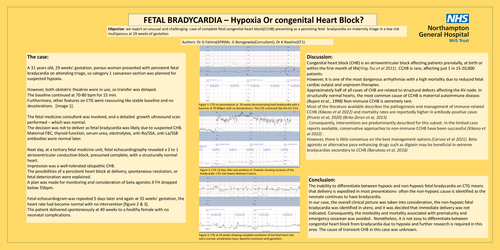
The case: A 31 years old, 29 weeks' gestation, parous woman presented with persistent fetal bradycardia on attending triage, so category 1 caesarean section was planned for suspected hypoxia.However, both obstetric theatres were in use, so transfer was delayed.The baseline continued at 70-80 bpm for 15 min. Furthermore, other features on CTG were reassuring like stable baseline and no decelerations. [image 1].
The fetal medicine consultant was involved, and a detailed growth ultrasound scan performed – which was normal.The decision was not to deliver as fetal bradycardia was likely due to suspected CHB.Maternal FBC, thyroid function, serum urea, electrolytes, anti-Ro/SSA, anti-La/SSB antibodies were normal later.
Next day, at a tertiary fetal medicine unit, fetal echocardiography revealed a 2 to 1 atrioventricular conduction block, presumed complete, with a structurally normal heart.Impression was a well-tolerated idiopathic CHB.The possibilities of a persistent heart block at delivery, spontaneous resolution, or fetal deterioration were explained.A plan was made for monitoring and consideration of beta agonists if FH dropped below 55bpm.Fetal echocardiogram was repeated 5 days later and again at 35 weeks' gestation, the heart rate had become normal with no intervention [figure 2 & 3]. The patient delivered spontaneously at 40 weeks to a healthy female with no neonatal complications.
Discussion:Congenital heart block (CHB) is an atrioventricular block affecting patients prenatally, at birth or within the first month of life(Ying-Tzu et al 2021) . CCHB is rare, affecting just 1 in 15-20,000 patients. However, it is one of the most dangerous arrhythmias with a high mortality due to reduced fetal cardiac output and unproven therapies.Approximately half of all cases of CHB are related to structural defects affecting the AV node. In structurally normal hearts, the most common cause of CCHB is maternal autoimmune disease. (Buyon et al., 1998) Non-immune CCHB is extremely rare.
Most of the literature available describes the pathogenesis and management of immune-related CCHB (Kikano et al 2022) and mortality rates are reportedly higher in antibody-positive cases (Pruetz et al, 2020) (Brito-Zeron et al, 2015). Consequently, interventions are predominantly described for this subset. In the limited case reports available, conservative approaches to non-immune CCHB ave been successful (Kikano et al 2022) .
However, there is little consensus on the best management options (Caruso et al 2021). Beta agonists or alternative pace enhancing drugs such as digoxin may be beneficial in extreme bradycardias secondary to CCHB (Baruteau et al, 2016)
Conclusion:
The inability to differentiate between hypoxic and non-hypoxic fetal bradycardia on CTG means that delivery is expedited in most presentations- often the non-hypoxic cause is identified as the neonate continues to have bradycardia.
In our case, the overall clinical picture was taken into consideration, the non-hypoxic fetal bradycardia was identified in utero, and it was decided that immediate delivery was not indicated. Consequently, the morbidity and mortality associated with prematurity and emergency cesarean was avoided. . Nonetheless, it is not easy to differentiate between congenital heart block from bradycardia due to hypoxia and further research is required in this area. The cause of transient CHB in this case was unknown.