1,830 posters, 67 videos, 75 audios, 29 topics, 22 sessions, 4,727 authors, 1,697 institutions
ePostersLive by SciGen Technologies S.A. All rights reserved.
RCOG World Congress 2023
June 12 - 14, 2023 | London, UK

EP.1358
Five consecutive twin pregnancies with co-existing complete hydatidiform mole and normal fetus
Part of Topic
Fetal Medicine
Five consecutive twin pregnancies with complete hydatidiform mole and co-existing normal fetus
Despoina Kitmiridou1, Veronica R. Powys2, Geetanjali Sharma1, Alexandra E. Cairns1, Catherine Rose Grainger2
1Oxford University Hospitals NHS Foundation Trust, Oxford, 2Frimley Health NHS Foundation Trust, Slough
Introduction
Twin pregnancies with a co-existing complete hydatidiform mole and a normal fetus are rare (1:22,000-100,000) and high-risk. We present the clinical course of five consecutive pregnancies seen in a UK tertiary fetal medicine unit (FMU).
This small case series highlights that these patients require input from across the spectrum of Obstetrics and Gynaecology, including early pregnancy care; ultrasound and fetal medicine; abortion care; maternal medicine; and advanced surgical skills.
Methods
An ultrasound software search (01/01/2012-31/12/2022) revealed 196 cases with suspected molar pregnancy.
85 (43%) had histopathology results confirming gestational trophoblastic disease (GTD).
Five were seen in FMU and had histologically-confirmed twin pregnancies with a co-existing complete mole and normal fetus.
Case Report
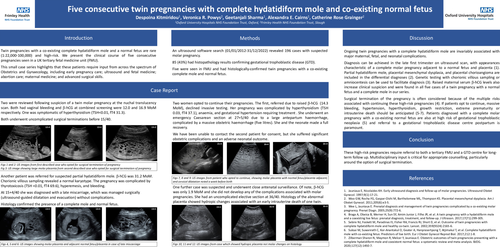
Two were reviewed following suspicion of a twin molar pregnancy at the nuchal translucency scan. Both had vaginal bleeding and b-hCG at combined screening were 12.0 and 16.9 MoM respectively. One was symptomatic of hyperthyroidism (TSH<0.01, fT4 31.3). Both underwent uncomplicated surgical terminations before 15/40.
Another patient was referred for suspected partial hydatidiform mole. b-hCG was 31.2 MoM. Chorionic villous sampling revealed a normal karyotype. The pregnancy was complicated by thyrotoxicosis (TSH <0.01, fT4 69.6), hyperemesis, and bleeding. At 15+4/40 she was diagnosed with a late miscarriage, which was managed surgically (ultrasound-guided dilatation and evacuation) without complications. Histology confirmed the presence of a complete mole and normal fetus.
Two women opted to continue their pregnancies. The first, referred due to raised b-hCG (14.3 MoM), declined invasive testing. Her pregnancy was complicated by hyperthyroidism (TSH 0.03, fT4 37.1), anaemia, and gestational hypertension requiring treatment . She underwent an emergency Caesarean section at 27+5/40 due to a large antepartum haemorrhage, complicated by a massive obstetric haemorrhage (five litres). She and the neonate made a full recovery.
We have been unable to contact the second patient for consent, but she suffered significant obstetric complications and an adverse neonatal outcome.
One further case was suspected and underwent close antenatal surveillance. Of note, b-hCG was only 1.9 MoM and she did not develop any of the complications associated with molar pregnancies. She had an uncomplicated elective section at 36/40. Histology of the abnormal placenta showed hydropic changes associated with an early intrauterine death of one twin.
Discussion
Ongoing twin pregnancies with a complete hydatidiform mole are invariably associated with major maternal, fetal, and neonatal complications.
Diagnosis can be achieved in the late first trimester on ultrasound scan, with appearances characteristic of a complete molar pregnancy adjacent to a normal fetus and placenta (1). Partial hydatidiform mole, placental mesenchymal dysplasia, and placental chorioangioma are included in the differential diagnoses (2). Genetic testing with chorionic villous sampling or amniocentesis can be used to facilitate diagnosis (3). Raised maternal serum b-hCG levels also increase clinical suspicion and were found in all five cases of a twin pregnancy with a normal fetus and a complete mole in our series.
Surgical termination of the pregnancy is often considered because of the multiple risks associated with continuing these high-risk pregnancies (4). If patients opt to continue, massive bleeding, hypertension, hyperthyroidism, growth restriction, extreme prematurity or intrauterine death should be anticipated (5-7). Patients diagnosed with a complete molar pregnancy with a co-existing normal fetus are also at high risk of gestational trophoblastic neoplasia (5) and referral to a gestational trophoblastic disease centre postpartum is paramount.
Conclusion
These high-risk pregnancies require referral to both a tertiary FMU and a GTD centre for long- term follow up. Multidisciplinary input is critical for appropriate counselling, particularly around the option of surgical termination.
References
1. Jauniaux E, Nicolaides KH. Early ultrasound diagnosis and follow-up of molar pregnancies. Ultrasound Obstet Gynecol. 1997;9(1):17-21.
2. Woo GW, Rocha FG, Gaspar-Oishi M, Bartholomew ML, Thompson KS. Placental mesenchymal dysplasia. Am J Obstet Gynecol. 2011;205(6):e3-5.
3. Wee L, Jauniaux E. Prenatal diagnosis and management of twin pregnancies complicated by a co-existing molar pregnancy. Prenat Diagn. 2005;25(9):772-6.
4. Braga A, Obeica B, Werner H, Sun SY, Amim Junior J, Filho JR, et al. A twin pregnancy with a hydatidiform mole and a coexisting live fetus: prenatal diagnosis, treatment, and follow-up. J Ultrason. 2017;17(71):299-305.
5. Sebire NJ, Foskett M, Paradinas FJ, Fisher RA, Francis RJ, Short D, et al. Outcome of twin pregnancies with complete hydatidiform mole and healthy co-twin. Lancet. 2002;359(9324):2165-6.
6. Suksai M, Suwanrath C, Kor-Anantakul O, Geater A, Hanprasertpong T, Atjimakul T, et al. Complete hydatidiform mole with co-existing fetus: Predictors of live birth. Eur J Obstet Gynecol Reprod Biol. 2017;212:1-8.
7. Zilberman Sharon N, Maymon R, Melcer Y, Jauniaux E. Obstetric outcomes of twin pregnancies presenting with a complete hydatidiform mole and coexistent normal fetus: a systematic review and meta-analysis. BJOG. 2020;127(12):1450-7.