1,830 posters, 67 videos, 75 audios, 29 topics, 22 sessions, 4,727 authors, 1,697 institutions
ePostersLive by SciGen Technologies S.A. All rights reserved.
RCOG World Congress 2023
June 12 - 14, 2023 | London, UK

EP.1346
“Shoulder dystocia in Thoraco-Omphalopagus conjoined Twins: A Case Report.’’
Poster Presenter
Authors
Affiliations
Part of Topic
Labour Ward Management
Shoulder dystocia in Thoraco-Omphalopagus conjoined Twins: A Case Report.
Objective
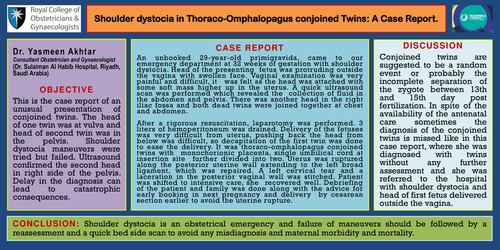
This is the case report of an unusual presentation of conjoined twins. The head of one twin was at vulva and head of second twin was in the pelvis. Shoulder dystocia maneuvers were tried but failed. Ultrasound confirmed the second head in right side of the pelvis. Delay in the diagnosis can lead to catastrophic consequences.
Case report:
An unbooked 29-year-old primigravida, came to our emergency department at 32 weeks of gestation with shoulder dystocia. Head of the presenting fetus was protruding outside the vagina with swollen face. Vaginal examination was very painful and difficult, it was felt as the head was attached with some soft mass higher up in the uterus .A quick ultrasound scan was performed which revealed the collection of fluid in the abdomen and pelvis .There was another head in the right iliac fossa and both dead twins were joined together at chest and abdomen .
After a rigorous resuscitation, laparotomy was performed. 3 liters of hemoperitoneum was drained. Delivery of the fetuses was very difficult from uterus, pushing back the head from below was difficult,so decapitation of the first twin was done to ease the delivery. It was thoraco-omphalopagus conjoined twins with monochorionic placenta,single umbilical cord at insertion site further divided into two. Uterus was ruptured along the posterior uterine wall extending to the left broad ligament, which was repaired.A left cervical tear and a laceration in the posterior vaginal wall was stitched .Patient was shifted to intensive care,she recovered well .Debrifing of the patient and family was done along with the advice for early booking in next pregnancy and delivery by cesarean section earlier to avoid the uterine rupture.
Discussion:
Conjoined twins are suggested to be a random event or probably the incomplete separation of the zygote between 13th and 15th day post fertilization. In spite of the availability of the antenatal care sometimes the diagnosis of the conjoined twins is missed like in this case report, where she was diagnosed with twins without any further assessment and she was referred to the hospital with shoulder dystocia and head of first fetus delivered outside the vagina.
Conclusions:
Shoulder dystocia is an obstetrical emergency and failure of maneuvers should be followed by a reassessment and a quick bed side scan to avoid any misdiagnosis and maternal morbidity and mortality.