1,830 posters, 67 videos, 75 audios, 29 topics, 22 sessions, 4,727 authors, 1,697 institutions
ePostersLive by SciGen Technologies S.A. All rights reserved.
RCOG World Congress 2023
June 12 - 14, 2023 | London, UK

EP.1335
Comparison of Vaginal Misoprostol versus Cervidil® for Induction of Labour
Poster Presenter
Part of Topic
Labour Ward Management
Clinical question:
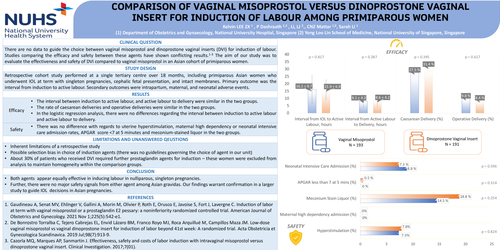
There are no data to guide the choice between vaginal misoprostol and dinoprostone vaginal inserts (DVI) for induction of labour. Studies comparing the efficacy and safety between these agents have shown conflicting results.1-3 The aim of our study was to evaluate the effectiveness and safety of DVI compared to vaginal misoprostol in an Asian cohort of primiparous women.
Study Design
Retrospective cohort study performed at a single tertiary centre over 18 months, including primiparous Asian women who underwent IOL at term with singleton pregnancies, cephalic fetal presentation, and intact membranes. Primary outcome was the interval from induction to active labour. Secondary outcomes were intrapartum, maternal, and neonatal adverse events.
Result:
Efficacy:
•The interval between induction to active labour, and active labour to delivery were similar in the two groups.
•The rate of caesarean deliveries and operative deliveries were similar in the two groups.
•In the logistic regression analysis, there were no differences regarding the interval between induction to active labour and active labour to delivery.
Safety:
•There was no difference with regards to uterine hyperstimulation, maternal high dependency or neonatal intensive care admission rates, APGAR score <7 at 5 minutes and meconium-stained liquor in the two groups.
LIMITATIONS AND UNANSWERED QEUSTIONS
•Inherent limitations of a retrospective study
•Possible selection bias in choice of induction agents (there was no guidelines governing the choice of agent in our unit)
•About 30% of patients who received DVI required further prostaglandin agents for induction – these women were excluded from analysis to maintain homogeneity within the comparison groups.
CONCLUSION
•Both agents appear equally effective in inducing labour in nulliparous, singleton pregnancies.
•Further, there were no major safety signals from either agent among Asian gravidas. Our findings warrant confirmation in a larger study to guide IOL decisions in Asian pregnancies.
REFERENCES
1.Gaudineau A, Senat MV, Ehlinger V, Gallini A, Morin M, Olivier P, Roth E, Orusco E, Javoise S, Fort J, Lavergne C. Induction of labor at term with vaginal misoprostol or a prostaglandin E2 pessary: a noninferiority randomized controlled trial. American Journal of Obstetrics and Gynecology. 2021 Nov 1;225(5):542-e1.
2.De Bonrostro Torralba C, Tejero Cabrejas EL, Envid Lázaro BM, Franco Royo MJ, Roca Arquillué M, Campillos Maza JM. Low‐dose vaginal misoprostol vs vaginal dinoprostone insert for induction of labor beyond 41st week: A randomized trial. Acta Obstetricia et Gynecologica Scandinavica. 2019 Jul;98(7):913-9.
3.Cazorla MQ, Marques AP, Sanmartin J. Effectiveness, safety and costs of labor induction with intravaginal misoprostol versus dinoprostone vaginal insert. Clinical Investigation. 2017;7(01).