1,830 posters, 67 videos, 75 audios, 29 topics, 22 sessions, 4,727 authors, 1,697 institutions
ePostersLive by SciGen Technologies S.A. All rights reserved.
RCOG World Congress 2023
June 12 - 14, 2023 | London, UK

EP.1334
Fighting Anemia in Newborns: Impact of Cord Clamping in the Developing World.
Poster Presenter
Authors
Hina Rajani, Sarah Charania, Omer Shaikh, Rabel Gul, Shaista Ehsan, Habiba Sharaf Ali
Affiliations
Part of Topic
Labour Ward Management
The Cord Connection: Optimising Timing on Neonatal Hematocrit Levels by Cord Clamping Authors: Hina, Sarah Charania, Omer Ahmed Shaikh, Rabel Gul, Shahista Ehsan, Habiba Sharaf Ali.
BACKGROUND: Optimal timing for cord clamping during the third stage of labor has been debatable. Early cord clamping(ECC) is common practice globally, but delayed cord clamping (DCC) offers benefits like enhanced blood volume and hematocrit, iron status. Iron deficiency anemia affects a significant portion of children, DCC is a suggested cost-effective method to reduce its incidence. However, DCC may lead to potential risks if not managed promptly, including resuscitation delays and neonatal complications. The WHO recommends cord clamping within one to three minutes, unless resuscitation is necessary.
STUDY PERIOD AND DESIGN: September 2021 to March 2022
Observational cross-sectional case-control study
SAMPLE SIZE: 80 pregnant women from Ziauddin Hospital Clifton Campus divided into two groups of ECC and DCC via randomisation using consecutive sampling, with 40 women in each.
ELIGIBILTY CRITERIA: Pregnant women at term (>37 weeks and <42 weeks) with fetus >2.5 kg, undergoing normal delivery or caesarean section, and willing to participate
DATA COLLECTION & ANALYSIS: Included recording delivery time, performing cord clamping immediately or after 120 seconds, observing neonatal outcomes and measuring hemoglobin/hematocrit levels at 72 hours. independent sample t-test and Mann-Whitney U test, with p<0.05 indicating statistical significance.
DISCUSSION: This study compared the effects of ECC and DCC on neonatal outcomes. It highlights the pivotal role of umbilical cord clamping in fetal anemia, we have come to conclude from our findings that DCC offers a more cost-effective intervention to reduce fetal anemias in newborns, particularly in resource-limited settings. However, due to time constraints and loss of patient follow-up, long-term benefits of DCC were not fully assessed. Further research and extended follow-up are warranted to gain a comprehensive understanding of benefits of DCC in neonatal health.
RESULTS:
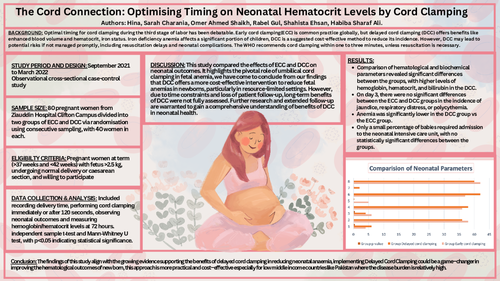
Comparison of hematological and biochemical parameters revealed significant differences between the groups, with higher levels of hemoglobin, hematocrit, and bilirubin in the DCC. On day 3, there were no significant differences between the ECC and DCC groups in the incidence of jaundice, respiratory distress, or polycythemia. Anemia was significantly lower in the DCC group vs the ECC group.
Only a small percentage of babies required admission to the neonatal intensive care unit, with no statistically significant differences between the groups.
Conclusion:Thefindingsofthisstudyalignwiththegrowingevidencesupportingthebenefitsofdelayedcordclampinginreducingneonatalanaemia,implementingDelayedCordClampingcouldbeagame--changerin improvingthehematologicaloutcomesofnewborn,thisapproachismorepracticalandcost--effectiveespeciallyforlowmiddleincomecountrieslikePakistanwherethediseaseburdenisrelativelyhigh.