1,830 posters, 67 videos, 75 audios, 29 topics, 22 sessions, 4,727 authors, 1,697 institutions
ePostersLive by SciGen Technologies S.A. All rights reserved.
RCOG World Congress 2023
June 12 - 14, 2023 | London, UK

EP.1319
“Comparison of different routes of hysterectomies in a tertiary care hospital, Pakistan”
Poster Presenter
Authors
Affiliations
Part of Topic
Benign Gynaecology
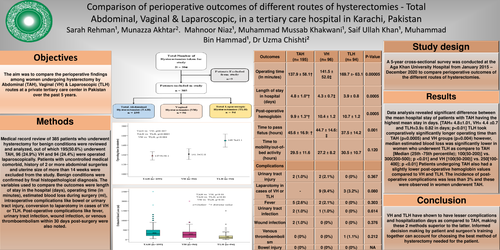
“Comparison of perioperative outcomes of different routes of hysterectomies - Total Abdominal, Vaginal & Laparoscopic, in a tertiary care hospital in Karachi, Pakistan”
Sarah Rehman¹, Munazza Akhtar2. Mahnoor Niaz¹, Muhammad Mussab Khakwani¹, Saif Ullah Khan¹, Muhammad Bin Hammad¹, Dr Uzma Chishti²
¹Medical College, Aga Khan University, Karachi, Pakistan
²Department of Obstetrics & Gynecology, Aga Khan University, Karachi, Pakistan
ABSTRACT
Background: This study was conducted to compare the perioperative findings among women undergoing hysterectomy by Abdominal (TAH), Vaginal (VH) & Laparoscopic (TLH) routes.
Methods: A 5-year cross-sectional survey was conducted at the Aga Khan University Hospital from January 2015–December 2020 to compare perioperative outcomes of the different routes of hysterectomies. Medical record review of 385 patients who underwent hysterectomy for benign conditions were reviewed and analyzed, out of which 195(50.6%) underwent TAH, 96 (24.9%) VH and 94 (24.4%) were operated laparoscopically Patients with uncontrolled medical comorbid, history of 2 or more abdominal surgeries and uterine size of more than 14 weeks were excluded from the study.
Results: revealed significant difference between the mean hospital stay of patients with TAH having the highest mean stay in days. [TAH= 4.8±1.01, VH= 4.4 ±0.7 and TLH=3.9± 0.82 in days; p<0.01] TLH took comparatively significantly longer operating time than TAH (p=0.0005) and VH groups (p=0.004) however, median estimated blood loss was significantly lower in women who underwent TLH as compare to TAH [Median (25th -75th percentile); 100(50-200)] vs. 300(200-500); p <0.01] and VH [100(50-200)] vs. 250[100-400]; p <0.01]. The incidence of post-operative complications was less than 3% and these were observed in women underwent TAH.
Conclusions: VH and TLH have lesser complications and hospitalization days as compared to TAH, making these 2 methods superior. Informed decision making by patient and surgeon’s training together can account for choosing the best method of hysterectomy suitable to the patient.

|
Variables |
TAH (n = 195) |
VH (n = 96) |
TLH (n = 94) |
P-Value |
|
Age of patient (years) |
45.5 ± 7.0*† |
57.8 0± 11.77‡ |
49.2 ± 10.2 |
0.0005 |
|
Comorbid
Hypertension |
64 (32.8%)*† |
55 (57.3%) |
44 (46.8%) |
0.0005 |
|
Diabetic Mellitus |
37 (19%)* |
29 (30%) ‡ |
15 (16%) |
0.010 |
|
Mean parity |
3.2 ± 3.07* |
4.1 ± 1.87‡ |
3.09 ± 1.63 |
0.0005 |
|
Uterine size (mm) AP Transverse craniocaudal dimension |
107.0 ± 30.8*† 64.5 ± 26.7*† 74.4 ± 31.3*† |
74.6 ± 18.2 41.9 ±1 8.2 46.5 ± 13.7 |
81.4 ± 15.4 48.0 ± 12.6 54.4 ± 15.1 |
0.0005 0.0005 0.0005 |
|
Preoperative hemoglobin |
11.5 ± 1.4*† |
12.3 ± 1.3 |
11.9 ± 1.2 |
0.0005 |
|
Previous abdominal surgeries 0 1-2 3-5 |
115 (59%)*† 60 (30.8%) 20 (10.3%) |
74 (77.1%) 21 (21.9%) 1(1%) |
79 (84%) 15 (16%) 0 (0%) |
0.0005 |
|
Uterine prolapse |
1 (0.5%) |
86 (90%) |
1 (1.1%) |
- |
|
Uterine fibroids |
97 (49.7%)*† |
2 (2.1%) ‡ |
21 (22.3%) |
0.0005 |
|
Endometrial hyperplasia |
11 (5.6%)*† |
0 (0%) |
10 (10.6%) |
0.005 |
|
Endometriosis |
29 (14.9%)*† |
1 (1%) |
6 (6.4%) |
0.0005 |
|
Adenomyosis |
3 (1.5%) |
0 (0%) |
1 (1.1%) |
0.477 |
|
Dysfunctional Uterine bleed |
34 (17.4%)*† |
4 (4.1%)‡ |
33 (35.1%) |
0.0005 |
|
Other |
16 (8.2%) |
3 (3.1%)‡ |
11 (11.7%) |
0.0005 |
|
Results are reported as mean ± SD and n (%) Multiple comparison: TAH vs. VH; *p<0.05 TAH vs. TLH: †p<0.01 AV vs. TLH: ‡<0.05
|
||||
|
Outcomes |
TAH (n= 195) |
VH (n= 96) |
TLH (n= 94) |
P-Value |
|
Operating time (In minutes) |
137.9 ± 58.1† |
141.5 ± 52.0‡
|
169.7 ±- 63.1 |
0.00005 |
|
Length of stay in hospital (days) |
4.8 ± 1.0*† |
4.3 ± 0.7‡ |
3.9 ± 0.8 |
0.0005 |
|
Post-operative hemoglobin |
9.9 ± 1.3*† |
10.4 ± 1.2 |
10.7 ± 1.2 |
0.0005 |
|
Time to pass flatus (hours) |
45.6 ± 16.9: † |
44.7 ± 14.6: ‡ |
37.5 ± 14.2 |
0.001 |
|
Time to mobility/out-of-bed activity (hours) |
29.5 ± 11.6 |
27.2 ± 8.2 |
30.5 ± 10.7 |
0.120 |
|
Complications |
|
|
|
|
|
Urinary tract injury |
2 (1.0%) |
2 (2.1%) |
0 (0%) |
0.367 |
|
Laparotomy in cases of VH or TLH |
- |
9 (9.4%) |
3 (3.2%) |
0.080 |
|
Fever |
5 (2.6%) |
2 (2.1%) |
0 (0%) |
0.303 |
|
Urinary tract infection |
2 (1.0%) |
1 (1.0%) |
0 (0%) |
0.614 |
|
Wound infection |
2 (1.0%) |
0 (0%) |
0 (0%) |
0.376 |
|
Venous thromboembolism |
0 (0%) |
0 (0%) |
1 (1.1%) |
0.212 |
|
Bowel injury |
0 (0%) |
0 (0%) |
0 (0%) |
NA |

