1,830 posters, 67 videos, 75 audios, 29 topics, 22 sessions, 4,727 authors, 1,697 institutions
ePostersLive by SciGen Technologies S.A. All rights reserved.
RCOG World Congress 2023
June 12 - 14, 2023 | London, UK

EP.1315
MICROBES AND ANTIBIOTICS SENSITIVITY IN PRETERM PRELABOUR RUPTURE OF MEMBRANES: RETROSPECTIVE ANALYSIS
Poster Presenter
Authors
Affiliations
Part of Topic
Fetal Medicine
MICROBES AND ANTIBIOTICS SENSITIVITY IN PRETERM PRELABOUR RUPTURE OF MEMBRANES: RETROSPECTIVE ANALYSIS
1. Oluwabusuyi Adebiyi 2. Victor Nwadike
1Department of Obstetrics and Gynaecology Federal Medical Centre, Abeokuta Ogun State. Nigeria
2Department of Medical Microbiology Federal Medical Centre, Abeokuta Ogun State. Nigeria
INTRODUCTION:
Preterm Prelabour rupture of membrane (PPROM) is associated with preterm deliveries and can result in significant neonatal morbidity and mortality. An understanding of the various causative organisms and antibiotics sensitivity pattern in our setting will not only help inform maternal and neonatal management thereby improving maternal and foetal outcomes but also ensure rational use of antibiotics.
OBJECTIVES:
To determine the prevalence of preterm prelabour rupture of membranes (PPROM), identify the prevalent microbes in the genital tract of pregnant women with PPROM and determine the antibiotics sensitivity pattern at the Federal Medical Centre Abeokuta (FMCA).
METHODS: This was a retrospective study of all women who presented with PPROM between January 2018 and December 2020. The patient admission records were checked for all cases of PPROM and the results of High Vagina Swab Microscopy Culture and Sensitivity (HVS M/C/S) were retrieved. The data were inputted in a proforma designed for the study and analysed using SPSS 25.
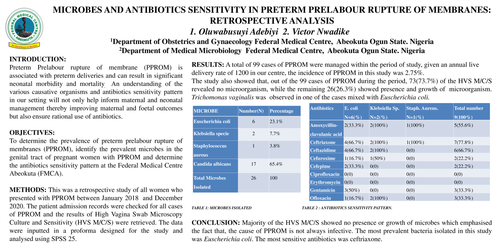
RESULTS: A total of 99 cases of PPROM were managed within the period of study, given an annual live delivery rate of 1200 in our centre, the incidence of PPROM in this study was 2.75%.
The study also showed that, out of the 99 cases of PPROM during the period, 73(73.7%) of the HVS M/C/S revealed no microorganism, while the remaining 26(26.3%) showed presence and growth of microorganism. Trichomonas vaginalis was observed in one of the cases mixed with Euscherichia coli.
CONCLUSION: Majority of the HVS M/C/S showed no presence or growth of microbes which emphasised the fact that, the cause of PPROM is not always infective. The most prevalent bacteria isolated in this study was Euscherichia coli. The most sensitive antibiotics was ceftriaxone.