1,830 posters, 67 videos, 75 audios, 29 topics, 22 sessions, 4,727 authors, 1,697 institutions
ePostersLive by SciGen Technologies S.A. All rights reserved.
RCOG World Congress 2023
June 12 - 14, 2023 | London, UK

EP.1314
Sexual dysfunction among women attending Female Genital Mutilation clinic.
Poster Presenter
Authors
Adam Koczoski, Trisha Valencia, Safiya Mohamud, Reeba Oliver
Affiliations
Part of Topic
Hot Topics (Emerging research/issues) in Gynaecology
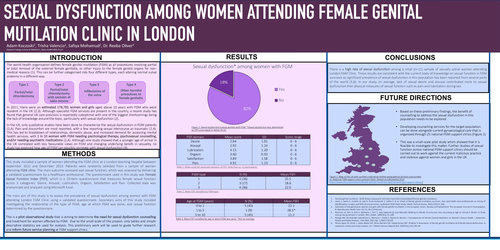
SEXUAL DYSFUNCTION AMONG WOMEN ATTENDING FEMALE GENITAL MUTILATION CLINIC IN LONDON
The world health organisation defines female genital mutilation (FGM) as all procedures involving partial or total removal of the external female genitalia, or other injury to the female genital organs for non-medical reasons (1). This can be further categorised into four different types, each altering normal vulval anatomy in a different way.
In 2011, there were an estimated 178,781 women and girls aged above 10 years with FGM who were resident in the UK (2,3). Although specialist FGM services are present in the country, a recent study has found that general UK care provision is reportedly suboptimal with one of the biggest shortcomings being the lack of knowledge around the topic, particularly with sexual dysfunction (2).
In the UK, only qualitative studies have been done to characterise the sexual dysfunction in FGM patients (2,4). Pain and discomfort are most reported, with a few reporting sexual intercourse as traumatic (2,4). This has led to breakdown of relationships, domestic abuse, and increased demand for accessing mental health services, with 1 in 10 women with FGM needing psychological therapy, psychosexual counselling, and/or needing psychiatric medications (2,4). Although one study showed that a younger age of arrival in the UK correlated with less favourable views on FGM and changing underlying beliefs in sexuality, no study has explored how age of FGM can possibly correlate with sexual dysfunction (4).
This study included a sample of women attending the FGM clinic at a London teaching hospital between September 2022 and December 2022. Patients were randomly selected from a sample of women attending FGM clinic. The main outcome assessed was sexual function, which was assessed by delivering a validated questionnaire by a healthcare professional. The questionnaire used in this study was Female Sexual Function Index (FSFI), which is a 19-item questionnaire that measures female sexual function across 5 categories: Desire, Arousal, Lubrication, Orgasm, Satisfaction and Pain. Collected data was anonymized and analyzed using Microsoft Excel.
The main aim of this study is to assess the prevalence of sexual dysfunction among women with FGM attending London FGM Clinic using a validated questionnaire. Secondary aims of this study included investigating the relationship of the type of FGM, age at which FGM was done, and sexual function determined by the questionnaire.
This is a pilot observational study that is aiming to determine the need for sexual dysfunction counselling and treatment for women affected by FGM. Due to the small-scale of this project, only tables and simple descriptive statistics are used for analysis. This preliminary work will be used to guide further research and inform future service planning at FGM support clinics.
There is a high rate of sexual dysfunction among a small (n=11) sample of sexually active women attending London FGM Clinic. These results are consistent with the current body of knowledge on sexual function in FGM survivors as significant prevalence of sexual dysfunction in this population has been reported from several parts of the world (5,6). In our study, on average, lack of sexual desire and arousal contributed more to sexual dysfunction than physical measures of sexual function such as pain and lubrication during sex.