1,830 posters, 67 videos, 75 audios, 29 topics, 22 sessions, 4,727 authors, 1,697 institutions
ePostersLive by SciGen Technologies S.A. All rights reserved.
RCOG World Congress 2023
June 12 - 14, 2023 | London, UK

EP.0130
Bariatric surgery impact on weight gain and outcomes in obese pregnant women
Poster Presenter
Authors
Affiliations
Part of Topic
Maternal Medicine
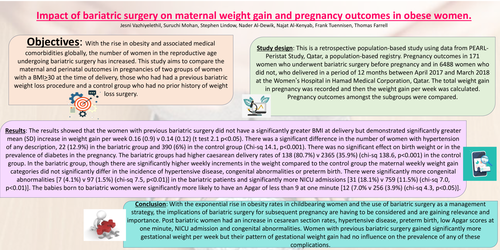
Impact of bariatric surgery on maternal weight gain and pregnancy outcomes in obese women.
Jesni Vazhiyelethil, Suruchi Mohan, Stephen Lindow, Nader Al-Dewik, Najat Al-Kenyab, Frank Tuennisen, Thomas Farrell
Objectives: With the rise in obesity and associated medical comorbidities globally, the number of women in the reproductive age undergoing bariatric surgery has increased. This study aims to compare the maternal and perinatal outcomes in pregnancies of two groups of women with a BMI>30 at the time of delivery, those who had had a previous bariatric weight loss procedure and a control group who had no prior history of weight loss surgery.
Study design: This is a retrospective population-based study using data from PEARL-Peristat Study, Qatar, a population-based registry. Pregnancy outcomes in 171 women who underwent bariatric surgery before pregnancy and in 6488 women who did not, who delivered in a period of 12 months between April 2017 and March 2018 at the Women’s Hospital in Hamad Medical Corporation, Qatar. The total weight gain in pregnancy was recorded and then the weight gain per week was calculated. Pregnancy outcomes amongst the subgroups were compared.
Results: The results showed that the women with previous bariatric surgery did not have a significantly greater BMI at delivery but demonstrated significantly greater mean (SD) increase in weight gain per week 0.16 (0.9) v 0.14 (0.12) (t test 2.1 p<0.05). There was a significant difference in the number of women with hypertension of any description, 22 (12.9%) in the bariatric group and 390 (6%) in the control group (Chi-sq 14.1, p<0.001). There was no significant effect on birth weight or in the prevalence of diabetes in the pregnancy. The bariatric groups had higher caesarean delivery rates of 138 (80.7%) v 2365 (35.9%) (chi-sq 138.6, p<0.001) in the control group. In the bariatric group, though there are significantly higher weekly increments in the weight compared to the control group the maternal weekly weight gain categories did not significantly differ in the incidence of hypertensive disease, congenital abnormalities or preterm birth. There were significantly more congenital abnormalities [7 (4.1%) v 97 (1.5%) (chi-sq 7.5, p<0.01)] in the bariatric patients and significantly more NICU admissions [31 (18.1%) v 759 (11.5%) (chi-sq 7.0, p<0.01)]. The babies born to bariatric women were significantly more likely to have an Apgar of less than 9 at one minute [12 (7.0% v 256 (3.9%) (chi-sq 4.3, p<0.05)].
Conclusion: With the exponential rise in obesity rates in childbearing women and the use of bariatric surgery as a management strategy, the implications of bariatric surgery for subsequent pregnancy are having to be considered and are gaining relevance and importance. Post bariatric women had an increase in cesarean section rates, hypertensive disease, preterm birth, low Apgar scores at one minute, NICU admission and congenital abnormalities. Women with previous bariatric surgery gained significantly more gestational weight per week but their pattern of gestational weight gain had no influence on the prevalence of any of these complications.