1,830 posters, 67 videos, 75 audios, 29 topics, 22 sessions, 4,727 authors, 1,697 institutions
ePostersLive by SciGen Technologies S.A. All rights reserved.
RCOG World Congress 2023
June 12 - 14, 2023 | London, UK

EP.1306
Retrospective Review: COVID-19 impacts on hysterosalpingogram’s service in Irish Regional Hospital
Poster Presenter
Authors
Affiliations
Part of Topic
Pandemic and impact of Covid/Infectious Diseases
Retrospective Review: COVID-19 impacts on hysterosalpingogram’s service in Irish Regional Hospital
Objective:
Tubal factor is one of the most common causes of female subfertility and is responsible for approximately 30% of cases.1 Hysterosalpingography (HSG) is recommended as first-line imaging for women with no comorbidities as it is reliable for assessing tubal patency and is less invasive.2
Fertility care services were largely disrupted by the Covid-19 global pandemic and rates of HSG is likely to fluctuate and plunge.3
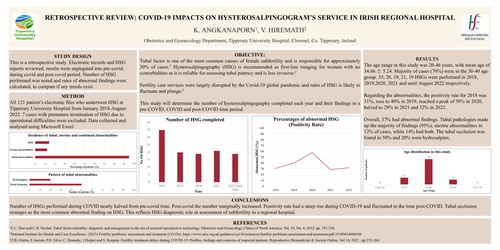
This study will determine the number of hysterosalpingography completed each year and their findings in a pre-COVID, COVID and post-COVID time period.
Design:
This is a retrospective study. Electronic records and HSG reports reviewed, results were segregated into pre-covid, during covid and post covid period. Number of HSG performed was noted and rates of abnormal findings were calculated, to compare if any trends exist.
Method:
All 121 patient’s electronic files who underwent HSG at Tipperary University Hospital from January 2018-August 2022. 7 cases with premature termination of HSG due to operational difficulties were excluded. Data collected and analysed using Microsoft Excel.
Results:
The mean age is 34.66 ± 5.24, with 70% of cases in 30-40 age group.
Regarding the abnormalities, the positivity rate for 2018 was 31%, rose to 40% in 2019, reached a peak of 58% in 2020, halved to 29% in 2021 and 32% in 2022.
Overall, 37% had abnormal findings. Tubal pathologies made up the majority of findings (95%), uterine abnormalities in 12% of cases, while 14% had both. The tubal occlusion was found in 50% and 20% were hydrosalpinx.
Conclusions: Number of HSGs performed during COVID nearly halved from pre-covid time. Post-covid the number marginally increased. Positivity rate had a steep rise during COVID-19 and fluctuated in the time post-COVID. Tubal occlusion resurges as the most common abnormal finding on HSG. This reflects HSG diagnostic role in assessment of subfertility in a regional hospital.
1E.C. Dun and C.H. Nezhat. Tubal factor infertility: diagnosis and management in the era of assisted reproductive technology. Obstetrics and Gynecology Clinics of North America. Vol. 39, No. 4, 2012: pp. 551-556.
2National Institute for Health and Care Excellence. (2013) Fertility problems: assessment and treatment (CG156). https://www.nice.org.uk/guidance/cg156/resources/fertility-problems-assessment-and-treatment-pdf-35109634660549
3Z.B. Gürtin, E Jasmin, P.D. Silva, C. Dennehy, J Harper and S. Kanjani. Fertility treatment delays during COVID-19: Profiles, feelings and concerns of impacted patients. Reproductive Biomedicine & Society Online. Vol 14, 2022 : pp 251-264.