1,830 posters, 67 videos, 75 audios, 29 topics, 22 sessions, 4,727 authors, 1,697 institutions
ePostersLive by SciGen Technologies S.A. All rights reserved.
RCOG World Congress 2023
June 12 - 14, 2023 | London, UK

EP.0129
Sexual quality of life in women before and after bariatric surgery
Poster Presenter
Part of Topic
Obesity
Objectives
To investigate female sexual quality of life (SQoL) in women of reproductive age living with severe obesity seeking bariatric surgery and the impact of bariatric surgery on female SQoL.
Design
Prospective cohort study of women 18-45 years undergoing bariatric surgery.
Participants were recruited pre-operatively and followed for 2 years post-operatively.
Validated SQoL questionnaire (SQoL-f)
pre-operatively, and at 3, 6, 12 and 24 months post-operatively.
Method
SQoL-f was selected because it is independent of sexual orientation or relationship status.
Scores range from 0 to 90 and are transformed into % (higher % represents greater SQoL).
A global score is given and a sub-scale score for 4 ‘factors: psychosexual feelings, self-worthlessness, sexual and relationship satisfaction and sexual repression.
Repeated measures ANOVA compared SQoL-f scores (both overall and by individual factor) over the five time-points and compared procedure type (bypass vs sleeve).
Results
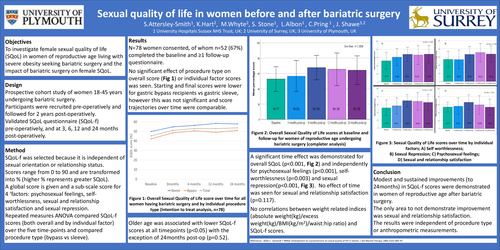
N=78 women consented, of whom n=52 (67%) completed the baseline and ≥1 follow-up questionnaire.
No significant effect of procedure type on overall score (Fig 1) or individual factor scores was seen. Starting and final scores were lower for gastric bypass recipients vs gastric sleeve, however this was not significant and score trajectories over time were comparable.
Older age was associated with lower SQoL-f scores at all timepoints (p<0.05) with the exception of 24months post-op (p=0.52).
Conclusion
Modest and sustained improvements (to 24months) in SQoL-f scores were demonstrated in women of reproductive age after bariatric surgery.
The only area to not demonstrate improvement was sexual and relationship satisfaction.
The results were independent of procedure type or anthropometric measurements.