1,830 posters, 67 videos, 75 audios, 29 topics, 22 sessions, 4,727 authors, 1,697 institutions
ePostersLive by SciGen Technologies S.A. All rights reserved.
RCOG World Congress 2023
June 12 - 14, 2023 | London, UK

EP.1297
Antimullerian Hormone Alone Does Not Predict In Vitro Fertilisation Pregnancy Rate
Poster Presenter
Part of Topic
Reproductive Medicine/Assisted Reproduction
Antimullerian Hormone Alone Does Not Predict In Vitro Fertilisation Pregnancy Rate
Artha Falentin Putri Susilo1; Kevin Dominique Tjandraprawira1; Tono Djuwantono1
1Department of Obstetrics and Gynecology, Faculty of Medicine, Universitas Padjadjaran – Dr. Hasan Sadikin General Hospital Bandung, Indonesia
Objective:
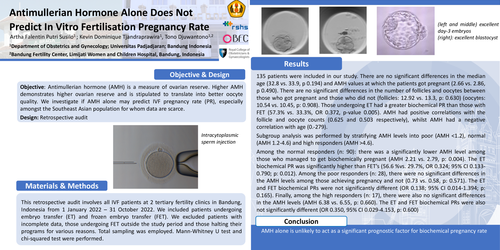
Antimullerian hormone (AMH) is a measure of ovarian reserve. Higher AMH demonstrates higher ovarian reserve and is stipulated to translate into better oocyte quality. We investigate if AMH alone may predict IVF pregnancy rate (PR), especially amongst the Southeast Asian population for whom data are scarce.
Design:
Retrospective audit
Materials & Methods:
This retrospective audit involves all IVF patients at 2 tertiary fertility clinics in Bandung, Indonesia from 1 January 2022 – 31 October 2022. We included patients undergoing embryo transfer (ET) and frozen embryo transfer (FET). We excluded patients with incomplete data, those undergoing FET outside the study period and those halting their programs for various reasons. Total sampling was employed. Mann-Whitney U test and chi-squared test were performed.
Results:
135 patients were included in our study. There are no significant differences in the median age (32.8 vs. 33.9, p 0.194) and AMH values at which the patients got pregnant (2.66 vs. 2.86, p 0.490). There are no significant differences in the number of follicles and oocytes between those who got pregnant and those who did not (follicles: 12.92 vs. 13.3, p: 0.630) (oocytes: 10.54 vs. 10.45, p: 0.908). Those undergoing ET had a greater biochemical PR than those with FET (57.3% vs. 33.3%, OR 0.372, p-value 0.005). AMH had positive correlations with the follicle and oocyte counts (0.625 and 0.503 respectively), whilst AMH had a negative correlation with age (0.-279).
Subgroup analysis was performed by stratifying AMH levels into poor (AMH <1.2), normal (AMH 1.2-4.6) and high responders (AMH >4.6). Among the normal responders (n: 90): there was a significantly lower AMH level among those who managed to get biochemically pregnant (AMH 2.21 vs. 2.79, p: 0.004). The ET biochemical PR was significantly higher than FET’s (56.6 %vs. 29.7%, OR 0.324; 95% CI 0.133-0.790; p: 0.012). Among the poor responders (n: 28), there were no significant differences in the AMH levels among those achieving pregnancy and not (0.73 vs. 0.58, p: 0.571). The ET and FET biochemical PRs were not significantly different (OR 0.138; 95% CI 0.014-1.394; p: 0.165). Finally, among the high responders (n: 17), there were also no significant differences in the AMH levels (AMH 6.38 vs. 6.55, p: 0.660). The ET and FET biochemical PRs were also not significantly different (OR 0.350, 95% CI 0.029-4.153, p: 0.600)
Conclusion:
AMH alone is unlikely to act as a significant prognostic factor for biochemical pregnancy rate