1,830 posters, 67 videos, 75 audios, 29 topics, 22 sessions, 4,727 authors, 1,697 institutions
ePostersLive by SciGen Technologies S.A. All rights reserved.
RCOG World Congress 2023
June 12 - 14, 2023 | London, UK

EP.1291
Foetal outcomes in cases of increased nuchal translucency in district general hospitals.
Poster Presenter
Part of Topic
Fetal Medicine
Investigating Foetal Outcomes in cases of increased Nuchal Translucency, in a District General Hospital
Sairana Abraham, Dr Manjambigai Sivaprakasam. (Year 5 medical student, Cardiff University)
Backrgound
Foetal development is carefully monitored throughout the course of pregnancy.
NICE provides detailed antenatal pathway guidelines1, to ensure proper management of mother and baby.
At around 11-13 weeks (in Wales) the ‘dating scan’ is performed as part of the initial screening tests, in which ultrasonography is used to take certain foetal measurements, which can be compared against the normal range of values.
Enlargements of the hypoechoic space posterior to the neck are recorded to be the nuchal translucency.
Higher nuchal translucency measurements have been associated with an increased risk of various issues:
Early identification of raised nuchal translucency is an important aspect of antenatal care, to better prepare for future potential consequences.
OBJECTIVES
This study aims to investigate the adverse outcomes and prognosis that is associated with nuchal translucency values over 3.5mm
METHODOLOGY
A retrospective analysis was performed on a cohort of patients from one District General Hospital. Records were accessed from fifty-eight individuals, across 2018-2021.
The inclusion criteria was patients whose recorded nuchal translucencies were over 3.5mm in the data scan, and sufficient clinical information was available.
The data was collated and analysed to identify any patterns in the effects of high nuchal translucencies (NT) on:
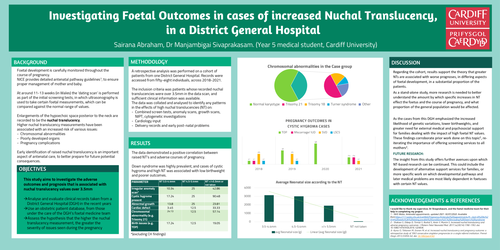
The data demonstrated a positive correlation between raised NT’s and adverse courses of pregnancy.
Down syndrome was highly prevalent, and cases of cystic hygroma and high NT was associated with low birthweight and poorer outcomes.
DISCUSSION
Regarding the cohort, results support the theory that greater NTs are associated with worse prognoses, in differing aspects of foetal development, in a substantial proportion of the patients.
As a stand-alone study, more research is needed to better understand the amount by which specific increases in NT effect the foetus and the course of pregnancy, and what proportion of the general population would be affected.
As the cases from this DGH emphasized the increased likelihood of genetic variations, lower birthweights, and greater need for external medical and psychosocial support for families dealing with the impact of high foetal NT values. These findings corroborate prior work done on this topic2, re-iterating the importance of offering screening services to all mothers3.
FUTURE RESEARCH:
The insight from this study offers further avenues upon which NT-based research can be continued. This could include the development of alternative support services for families, or more specific work on which developmental pathways and later medical problems are most likely dependent in foetuses with certain NT values.
ACKNOWLEDGEMENTS & REFERENCES
I would like to thank my supervisor, Dr Sivaprakasam, and the foetal medicine team for their help in completing my project.
1 - NHS Wales. Antenatal appointments. updated 2021. 02/07/2022. Available from:https://111.wales.nhs.uk/LiveWell/Pregnancy/Antenatal%20appointments/#:~:text=8%20to%2014%20weeks%3A%20dating,possible%20conditions%2C%20including%20Down's%20syndrome
2 - Shakoor S, Dileep D, Tirmizi S, Rashid S, Amin Y, Munim S. Increased nuchal translucency and adverse pregnancy outcomes. J Matern Fetal Neonatal Med. 2017 Jul;30(14):1760-1763. doi: 10.1080/14767058.2016.1224836.
3 - Ayras O, Tikkanen M, Eronen M, et al. Increased nuchal translucency and pregnancy outcome: a retrospective study of 1063 consecutive singleton pregnancies in a single referral institution. Prenat Diagn 2013;33:856–62, doi: 10.1002/pd.4143