1,830 posters, 67 videos, 75 audios, 29 topics, 22 sessions, 4,727 authors, 1,697 institutions
ePostersLive by SciGen Technologies S.A. All rights reserved.
RCOG World Congress 2023
June 12 - 14, 2023 | London, UK

EP.1290
Lessons from a serious incident: intrapartum fluid management and hyponatraemia
Poster Presenter
Authors
Madeleine Malina, Mahmoud Awaly, Alina Unipan, Michael Magro
Affiliations
Part of Topic
Labour Ward Management
Lessons from a serious incident:
Intrapartum fluid management and hyponatraemia
Madeleine Malina, Mahmoud Awaly, Alina Unipan, Michael Magro
Background and objective
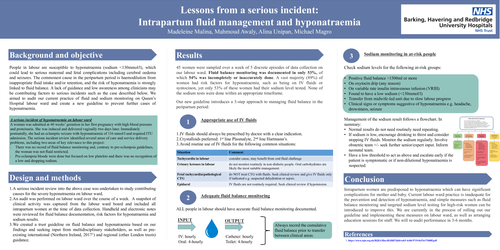
People in labour are susceptible to hyponatraemia (sodium <130mmol/l), which could lead to serious maternal and fetal complications including cerebral oedema and seizures. The commonest cause in the peripartum period is haemodilution from inappropriate fluid intake and/or retention, and the risk of hyponatraemia is strongly linked to fluid balance. A lack of guidance and low awareness among clinicians may be contributing factors to serious incidents such as the case described below. We aimed to audit our current practice of fluid and sodium monitoring on Queen’s Hospital labour ward and create a new guideline to prevent further cases of hyponatraemia.
A serious incident of hyponatraemia on labour ward
A woman was admitted at 40 weeks’ gestation in her first pregnancy with high blood pressure and proteinuria. She was induced and delivered vaginally two days later. Immediately postnatally, she had an eclamptic seizure with hyponatraemia of 116 mmol/l and required ITU admission. The serious incident review identified several areas of care and service delivery problems, including two areas of key relevance to this project:
Design and methods
Results
45 women were sampled over a week of 5 discrete episodes of data collection on our labour ward. Fluid balance monitoring was documented in only 53%, of which 54% was incompletely or inaccurately done. A vast majority (89%) of women had risk factors for hyponatraemia, such as being on IV fluids or syntocinon, yet only 53% of these women had their sodium level tested. None of the sodium tests were done within an appropriate timeframe.
Our new guideline introduces a 3-step approach to managing fluid balance in the peripartum period:
1. Appropriate use of IV fluids
Tachycardia in labour- consider cause, may benefit from oral fluid challenge
Urinary ketones in labour- do not monitor routinely in non-diabetic people. Oral carbohydrates are likely the most suitable management.
Fetal tachycardia/pathological CTG- do NOT treat CTG with fluids. Seek clinical review and give IV fluids only if indicated e.g. suspected dehydration or sepsis.
Epidural- IV fluids are not routinely required. Seek clinical review if hypotension.
2. Adequate fluid balance monitoring
ALL people in labour should have accurate fluid balance monitoring documented.
Input: IV hourly, Oral 4-hourly
Output: Catheter hourly, toilet 4-hourly
Always record the cumulative fluid balance prior to transfer between clinical areas.
3. Sodium monitoring in at-risk people
Check sodium levels for the following at-risk groups:
Management of the sodium result follows a flowchart. In summary:
Intrapartum women are predisposed to hyponatraemia which can have significant complications for mother and baby. Current labour ward practice is inadequate for the prevention and detection of hyponatraemia, and simple measures such as fluid balance monitoring and targeted sodium level testing for high-risk women can be introduced to improve this. We are currently in the process of rolling out our guideline and implementing these measures on labour ward, as well as arranging education sessions for staff. We will re-audit performance in 3-6 months.