1,830 posters, 67 videos, 75 audios, 29 topics, 22 sessions, 4,727 authors, 1,697 institutions
ePostersLive by SciGen Technologies S.A. All rights reserved.
RCOG World Congress 2023
June 12 - 14, 2023 | London, UK

EP.1284
Importance of genetic links in determining public attitudes towards surrogacy.
Poster Presenter
Authors
Akhila Munasinghe, Lakindu Grero, Janith Gamage, Janani Withana, Shamini Prathapan, Ramya Pathiraja, Dulanji Beneragama
Affiliations
Faculty of Medical Sciences, University of Sri Jayewardenepura, Sri Lanka, Department of Community Medicine, Faculty of Medical Sciences, University of Sri Jayewardenepura, Sri Lanka., Department of Obstetrics and Gynecology, Faculty of Medical Sciences, University of Sri Jayewardenepura, Sri Lanka
Part of Topic
Reproductive Medicine/Assisted Reproduction
Importance of genetic links in determining public attitudes towards surrogacy.
Beneragama DM1, Grero KLW1, Gamage TGJN1, Munasinghe MAA1, Withana JL1, Pathiraja RP2, Prathapan S3
1Faculty of Medical Sciences, University of Sri Jayewardenepura, Sri Lanka; 2Department of Obstetrics and Gynecology, Faculty of Medical Sciences, University of Sri Jayewardenepura, Sri Lanka; 3Department of Community Medicine, Faculty of Medical Sciences, University of Sri Jayewardenepura, Sri Lanka.
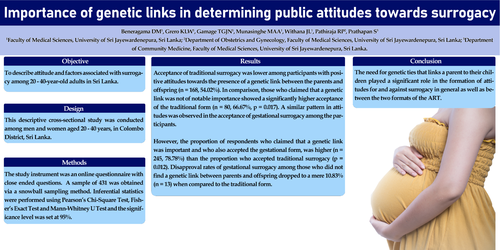
Objective: To describe attitude and factors associated with surrogacy among 20 - 40-year-old adults in Sri Lanka.
Design: This descriptive cross-sectional study was conducted among men and women aged 20 - 40 years, in Colombo District, Sri Lanka.
Methods: The study instrument was an online questionnaire with close ended questions. A sample of 431 was obtained via a snowball sampling method. Inferential statistics was performed using Pearson’s Chi-Square Test, Fisher’s Exact Test and Mann-Whitney U Test and the significance level was set at 95%.
Results: Acceptance of traditional surrogacy was lower among participants with positive attitudes towards the presence of a genetic link between the parents and offspring (n = 168, 54.02%). In comparison, those who claimed that a genetic link was not of notable importance showed a significantly higher acceptance of the traditional form (n = 80, 66.67%, p = 0.017). A similar pattern in attitudes was observed in the acceptance of gestational surrogacy among the participants. However, the proportion of respondents who claimed that a genetic link was important and who also accepted the gestational form, was higher (n = 245, 78.78%) than the proportion who accepted traditional surrogacy (p = 0.012). Disapproval rates of gestational surrogacy among those who did not find a genetic link between parents and offspring dropped to a mere 10.83% (n = 13) when compared to the traditional form.
Conclusion: The need for genetic ties that links a parent to their children played a significant role in the formation of attitudes for and against surrogacy in general as well as between the two formats of the ART.