1,830 posters, 67 videos, 75 audios, 29 topics, 22 sessions, 4,727 authors, 1,697 institutions
ePostersLive by SciGen Technologies S.A. All rights reserved.
RCOG World Congress 2023
June 12 - 14, 2023 | London, UK

EP.1279
CIN 2 Conservative management: 3 Year Follow up Study
Poster Presenter
Authors
Affiliations
Part of Topic
Gynae Oncology
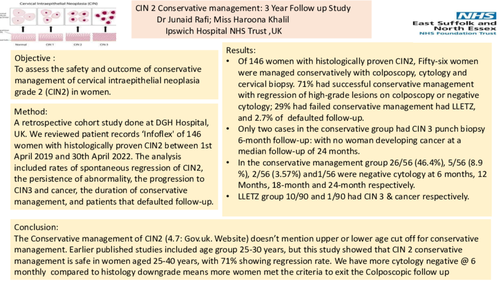
Objective: To assess the safety and outcome of conservative management of cervical intraepithelial neoplasia grade 2 (CIN2) in women.
Study design: A retrospective cohort study done at DGH Hospital, UK. We reviewed patient records ‘Infoflex' of 146 women with histologically proven CIN2 between 1st April 2019 and 30th April 2022. The analysis included rates of spontaneous regression of CIN2, the persistence of abnormality, the progression to CIN3 and cancer, the duration of conservative management, and the number of patients that defaulted follow-up.
Results: Of 146 women, 90 women underwent primary treatment of CIN2 with large loop excision of the transformation zone (LLETZ). Fifty-six women were managed conservatively with colposcopy, cytology and cervical biopsy. Overall, 71% had successful conservative management with regression of high-grade lesions on colposcopy and negative cytology; 29% had failed conservative management and had LLETZ, and 2.7% of women defaulted follow-up. Only two cases in the conservative group had CIN 3 punch biopsy 6-month follow-up: with no woman developing cancer at a median follow-up of 24 months. In the conservative management group 26/56 (46.4%), 5/56 (8.9 %), 2/56 (3.57%) and1/56 were negative cytology at 6 months, 12 Months, 18-month and 24-month respectively.
In the LLETZ group, there were 90/146 women who had treatment. Out of those 26 were heavy smokers (ten or more cigarettes/day) and 20 patients opted for LLETZ over conservative management as a personal choice. Overall, 10/90 and 1/90 women who had LLETZ as primary treatment had CIN 3 and cancer respectively.
In women with successful conservative management features of Cytology resolved in a shorter time period compared to normalisation of their high-grade dysplasia on colposcopy and biopsy.
Conclusion: The Conservative management of CIN2 (4.7: Gov. uk. Website) doesn’t mention an upper or lower age cut-off for conservative management. Earlier published studies included the age group 25-30 years, but this study showed that CIN 2 conservative management is safe in women aged 25-40 years, with 71% showing a regression rate. Unlike other studies in the past, we observed that there is less time lag before cytology becomes negative than regression of high-grade lesion on colposcopy, signifies cytology as well as colposcopy +/-biopsy at 6 months follow up to be the safest follow-up option. Being advocates of conservative management we also like to emphasise that ‘’See and Treat’’ stays a valid option as 10 cases of CIN 3 and one case of Cancer was picked up in the LLETZ group