1,830 posters, 67 videos, 75 audios, 29 topics, 22 sessions, 4,727 authors, 1,697 institutions
ePostersLive by SciGen Technologies S.A. All rights reserved.
RCOG World Congress 2023
June 12 - 14, 2023 | London, UK

EP.1278
Primary versus Delayed Primary Closure of Skin Incision in CS- a Comparison
Part of Topic
Hot Topics (Emerging research/issues) in Obstetrics
Audio
INTRODUCTION
Surgical Site Infection (SSI) is the second most common infection after urinary tract infection in caesarean deliveries. 1 Though SSI rarely becomes a life threatening complication but it is associated with morbid consequences leading to prolonged hospital stay and economic burden to the health care system. Caesarean deliveries in emergency situation where the amniotic membrane is ruptured are clean contaminated procedures which are associated with 10-20% wound disruptions 1, 2 and antibiotic prophylaxis should be done in clean contaminated wounds but it may not prevent the consequences of intra operative contaminations.
Studies showed that delayed primary closure could more significantly reduce wound infection rates than primary closure of skin margins. The values of delayed primary closure (DPC) for managing contaminated wounds were well recognized by military surgeons.
We aimed in this randomized trial to determine the outcome of wound health in delayed primary closure in comparison to primary closure in emergency CS.
METHODS
An open label randomized control trial was conducted at Calcutta National Medical College and Hospital, Kolkata ,India. Pregnant mothers undergoing emergency caesarean sections were enrolled between March 1 2021 to June 15 2021. The study was started after being approved by institutional ethics board and a written consent was obtained from each eligible participant. During the study period only those participants having ruptured membranes were included and wound was defined as either clean contaminated ( less than 12 hours) or contaminated (more than 12 hours) depending upon the duration of membrane rupture.2 Women with prelabour rupture of membranes undergoing CS were counselled about the two different types of skin apposition and screened for eligibility. Women with intact membranes, conditions where incision other than Pfannenstiel was required, features of chorioamnionitis were excluded from this study. Once the decision of emergency CS was made, women were randomized through a computer generated number sequence into Group A or study group and Group B or control group. All of them received injection ampicillin 1 gram prophylactically within thirty minutes of making abdominal incision.
In Group A at the end of the procedure after closure of rectus sheath with 1-0 Vicryl skin and subcutaneous tissue were left open. Stiches taken with 1-0 monofilament but knots were not tightened. From second day onwards wound dressing was done with normal saline after cleaning the skin with 5 % povidone iodine solution for consecutive 3 days . On 5th day stitches taken were tightened under local anaesthesia and were removed on 7th day. In Group B margins of skin incision were apposed by usual primary closure using 1-0 monofilament and stiches were removed on 6th day after CS. For any sort of abnormal discharge from wounds ,swabs were taken for bacterial culture sensitivity test. For wound dehiscence secondary closure was done when there was adequate granulation tissue developed after wound dressing with normal saline and antibiotic ointment.
Demographic information, indications of caesarean sections and other host related variables like age, parity, BMI, previous scar, medical co-morbidities, induction/ augmentation of labour were recorded. Surgery related data included duration of surgery, pre and post operative haemoglobin and haematocrit values and duration of hospital stay in days.
Statistical methods- Linear data were represented as mean ± standard deviation for normally distributed data and as mean (interquartile range (IQR)) for not-normally distributed data. Categorical data were represented as percentage (frequency). Comparison of means were done with Mann Whitney U test and comparison of proportions with Chi – squared test or Fisher’s exact test as appropriate.
RESULTS
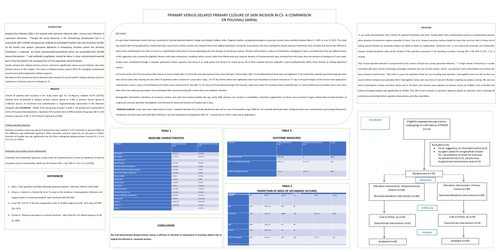
Overall 70 patients were included in the study (mean age 25.1 ±4.46years, nullipara 45.7% (32/70)). Patients were randomized to delayed primary closure (group A, n=40) or primary closure (group B, n=30).The process of enrolment and randomisation is diagrammatically represented in the flowchart alongside called Enrolment . Details of the two groups are given in table 1. The groups were comparable in terms of the presented parameters. Operation (OT) duration did not differ between the groups (58.5 ± 15.8 minutes in group A vs 58.7 ± 18.5 minutes in group B, p=0.96).
Primary outcome measure:
Need for secondary suture was absent in group A but was needed in 1/3rd of patients in group B (Table 2). The difference was statistically significant. Other secondary outcome measures are also given in Table2. Duration of hospital stay was significantly less for those undergoing delayed primary closure(7.6 ± 3.4 vs 5.6 ± 0.5, p= 0.003 ).
Prediction of secondary suture requirement:
Univariate and multivariate regression results (table 3) showed presence of only one predictor of need for secondary suture in pooled data, which was OT duration (OR = 1.06, 95% CI: 1.01-1.11, p=0.029).
DISCUSSION
In our study all participants had a history of ruptured membrane and were having either clean contaminated wounds or contaminated wounds when duration of membrane rupture exceeded 12 hours. Tran et al showed caesarean sections lasted for more than one hour had 2.4 times risk of having wound infection by univariate analysis but failed to detect its independent predictive role.4 In our study both univariate and multivariate analyses showed predictive value of the duration of the operative procedure in SSI requiring secondary suturing (OR =1.06, 95% CI:1.01- 1.11, p =0.029).
Risk of post-operative infection is proportional to the volume of blood loss during caesarean deliveries. 3, 4 A high volume of blood loss is usually associated with poor control of bleeding, prolonged retraction and use of more sutures. Suture can promote more contamination and reduce the local resistance mechanisms. 4 We tried to assess the operative blood loss by recording post-operative haemoglobin level and did not find any causal relation between post-operative fall in haemoglobin values and occurrence of wound infections requiring secondary suturing. We saw one third of participants needed secondary stiches due to SSI where skin incisions were apposed by primary closure (p =0.0001). Such morbidity had further prolonged hospital stay significantly (p =0.003). Thus DPC of skin incisions in caesarean deliveries played an important role in reducing SSI and thereby preventing further operative interventions and other morbidities.
Conclusion : This trial demonstrated delayed primary closure is effective in reduction of requirement of secondary stitches due to surgical site infection in caesarean sections.
REFERENCES