1,830 posters, 67 videos, 75 audios, 29 topics, 22 sessions, 4,727 authors, 1,697 institutions
ePostersLive by SciGen Technologies S.A. All rights reserved.
RCOG World Congress 2023
June 12 - 14, 2023 | London, UK

EP.1273
Induction of labour Indication and outcomes: Review at Al Wakra Hospital Qatar
Poster Presenter
Part of Topic
Labour Ward Management
Induction of labour Indication and outcomes: Review at Al Wakra Hospital Qatar
Joohi Ramawat, Nadjet Ounissi, Abdul Hadi Mohammad Salem, Yousra Shehada Siam, Lolwa Mohammed Alansari
Introduction
Induction of labor (IOL) is one of the most common intervention in a busy labor ward in any obstetric unit today. There seems to be increasing rate and wide variation in incidence and indication of IOL worldwide. WHO recommends that IOL should be done with proper indication to provide best care and outcome to mother and baby. It is critical for all obstetric units to review their own practice of induction of labor for better maternal and neonatal outcomes
Objective
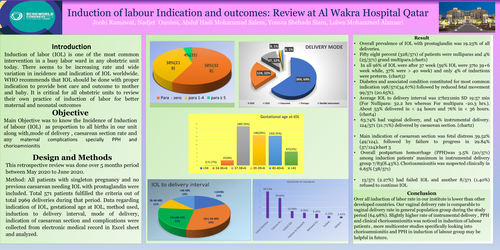
Main Objective was to know the Incidence of Induction of labour (IOL) as proportion to all births in our unit along with,mode of delivery , caesarean section rate and any maternal complications specially PPH and chorioamnionitis
Design and Methods
This retrospective review was done over 5 months period between May 2020 to June 2020.
Method: All patients with singleton pregnancy and no previous caesarean needing IOL with prostaglandin were included. Total 571 patients fulfilled the criteria out of total 2969 deliveries during that period. Data regarding indication of IOL, gestational age at IOL, method used, induction to delivery interval, mode of delivery, indication of caesarean section and complications were collected from electronic medical record in Excel sheet and analyzed.
Result
Conclusion
Over all induction of labor rate in our institute is lower than other developed countries. Our vaginal delivery rate is comparable to vaginal delivery rate in general population group during the study period (64.98%). Slightly higher rate of instrumental delivery , PPH and clinical chorioamnionitis was noticed in induction of labour patients , more multicenter studies specifically looking into chorioamnionitis and PPH in induction of labour group may be helpful in future.