1,830 posters, 67 videos, 75 audios, 29 topics, 22 sessions, 4,727 authors, 1,697 institutions
ePostersLive by SciGen Technologies S.A. All rights reserved.
RCOG World Congress 2023
June 12 - 14, 2023 | London, UK

EP.1263
Wound infection and dehiscence of perineal tears among women giving vaginal delivery
Part of Topic
Labour Ward Management
Wound infection and dehiscence of perineal tears among women giving vaginal delivery.
Ngo Thi Thanh Thao, MD, MSc1,Vương Thi Ngoc Lan, Assoc.Prof;MD.PhD2, Nguyen Van Hung, MD, MHPE, PhD3, , Huynh Ngoc Phuoc 4, Ho Thi Xuan Nuong, MD5 , Phan Thi Hang, MD, PhD6.
(1) Obstetrician, Labour and delivery Department, Hung Vuong Hospital, Ho Chi Minh city, Vietnam
(2) Head, Department of Obstetrics and Gynecology, University of Medicine and Pharmacy, Ho Chi Minh city, Vietnam.
(3) Head, Department of Health Psychology, Office of Personnel Management - Administration - Inspection and Legislation, Hue UMP.
Lecturer of Health Psychology, Health Education and Health ManagementMedical Ethics ; Vice-Dean Faculty of Public Health, Hue University of Medicine and Pharmacy, Vietnam.
(4) Bachelor of Public Health, General Planning, Hung Vuong Hospital, Ho Chi Minh city, Vietnam.
(5) Obstetrician, Post-partum Department, Hung Vuong Hospital, Ho Chi Minh city, Vietnam.
(6) Vice-Director, Hung Vuong Hospital, Ho Chi Minh city, Vietnam.
Abstract
Objective: To determine the prevalence of wound infection and dehiscence of perineal tears and its associated factors among women giving vaginal delivery without prophylactic antibiotic.
Design: A prospective cohort study
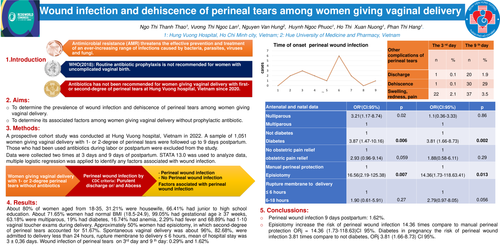
Methods: A prospective cohort study involving 1.051 women giving vaginal delivery without prophylactic antibiotic was carried-out at Hung Vuong Maternal Hospitals at Ho Chi Minh city in Vietnam from March to June, 2022 (no drop - out). Post-partum women with first- or second-degree perineal tears were followed-up until 9 days of post-partum. We evaluated the symptoms of perineal wound infection, dehiscence, and other complications such as serous discharge, swelling, redness, and pain at the 3rd and 9th day of post-partum . CDC criteria was applied for diagnosing episiotomy infection cases. Data were analyzed using the STATA version 13.0. Logistic regression analysis was performed to determine the factors associated with infection and dehiscence of perineal tears.
Results: Mean of age was 29.43 years (SD= 6,05). Among 1.051 woman, 36.82% of those was primiparous, 49.86% was episiotomy, 51.67% woman had degree 2 of perineal tear and the remaining 48.33% had degree 1 of perineal tear.
At day 3 of post-partum, prevalence of wound infection was 0.29%, swelling but no redness nor pain was accounted for 4.66%. At day 9 of post-partum, the prevalence of wound infection was 1.62%. Other complications such as serum discharge, wound dehiscence, swelling were 1.93%, 2.8%, and 3.29%, respectively. Episiotomy and gestational diabetes were found to be the significant factors associated with perineal wound infection, aOR = 13.79; 95% CI:1.67-114.04 and aOR = 4.24; 95% CI:1.61-11.74, respectively.
Conclusion: Most of perineal wound infection was found from day 3 until day 9 of post-partum. Episiotomy and diabetes might be the significante risk factors of perineal wound infection.
Keywords: Wound infection, Hung Vuong Maternal Hospital, Ho Chi Minh city, Vietnam