1,830 posters, 67 videos, 75 audios, 29 topics, 22 sessions, 4,727 authors, 1,697 institutions
ePostersLive by SciGen Technologies S.A. All rights reserved.
RCOG World Congress 2023
June 12 - 14, 2023 | London, UK

EP.1259
Unexpected pregnancy after laparoscopic bilateral salpingectomy and insertion of Mirena
Poster Presenter
Authors
Sajith Uditha Asanka Kodithuwakku, Premjit Gill, Bethany Sampson, Kuhan Ravi
Affiliations
Part of Topic
Benign Gynaecology
Unexpected pregnancy after laparoscopic bilateral salpingectomy and insertion of Mirena
Objectives
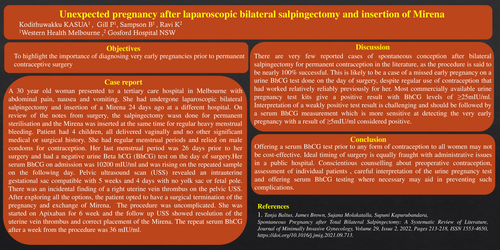
To highlight the possibility of missing the diagnosis of very early pregnancies in routine preoperative investigations.
Case report
A 30 year old woman presented to a tertiary care hospital in Melbourne with abdominal pain, nausea and vomiting. She had undergone laparoscopic bilateral salpingectomy and insertion of a Mirena 24 days ago at a different hospital. On review of the notes from surgery, the salpingectomy wasn done for permanent sterilisation and the Mirena was inserted at the same time for regular heavy menstrual bleeding. Patient had 4 children, all delivered vaginally and no other significant medical or surgical history. She had regular menstrual periods and relied on male condoms for contraception. Her last menstrual period was 26 days prior to her surgery had a negative urine Beta hCG(BhCG) test on the day of surgery.
Her serum BhCG on admission was 10200 mIU/ml and was rising on the repeated sample on the following day. Pelvic ultrasound scan (USS) revealed an intrauterine gestational sac compatible with 5 weeks and 4 days with no yolk sac or fetal pole. There was an incidental finding of a right uterine vein thrombus on the pelvic USS.
After exploring all the options, the patient opted to have a surgical termination of the pregnancy and exchange of Mirena. The procedure was uncomplicated. She was started on Apixaban for 6 week and the follow up USS showed resolution of the uterine vein thrombus and correct placement of the Mirena. The repeat serum BhCG after a week from the procedure was 36 mIU/ml.
Discussion
There are only few cases reported in the literature for spontaneous conception after bilateral salpingectomy. This is possibly a case of very early pregnancy which was missed in the urine BhCG test done on the day of surgery. Most commercially available urine BhCG tests kits give a positive result at serum BhCG level of 25 mIU/ml or above. However, interpretation of a weakly positive test result is challenging and ambiguous. Measurement of serum BhCG level is more sensitive in detecting an early pregnancy and a result of 5 mIU/ml or above is considered positive.
Conclusion
Offering a serum BhCG test for all pre operative women in reproductive age may not be cost-effective. However, careful assessment of each patient and offering a suitable pregnancy test will aid to prevent such complications.