1,830 posters, 67 videos, 75 audios, 29 topics, 22 sessions, 4,727 authors, 1,697 institutions
ePostersLive by SciGen Technologies S.A. All rights reserved.
RCOG World Congress 2023
June 12 - 14, 2023 | London, UK

EP.1254
Qualitative Study Evaluation on the impact of antenatal education on fetal movements
Poster Presenter
Authors
Affiliations
Part of Topic
High Risk Pregnancy
Qualitative study undertaken in a single center in UAE evaluating the impact of information on fetal movements provided to pregnant women
Authors: Dr. Raoya Farah, Dr. Rimpi Datta, Dr. Rawan Al Shurafaa, Dr. Iram Siddiqui
Department of Obstetrics and Gynecology, Mediclinic Al Noor Hospital, Abu Dhabi, UAE
Background
Reduced fetal movement can be regarded as an important symptom of fetal compromise. During pregnancy, maternal perception of fetal movements is one of the first signs of fetal life and is regarded as a manifestation of fetal well-being (1). As such a significant reduction or sudden alteration in fetal movements is a potentially important clinical sign and therefore, a cause for concern for both the mother and obstetrician (2).
Furthermore, reduced fetal movement is affiliated with potentially poor perinatal outcomes, due to its association with a variety of pregnancy complications, including oligohydramnios, neuromuscular abnormalities, brain injuries, small for gestational age fetuses (SGA), fetal growth restriction (FGR), and stillbirth (3). Studies have shown that in stillbirths present with reduced fetal movements, placental insufficiency is existing alongside (3). Therefore, reduced fetal movement is thought of as a fetal adaptive mechanism to reduce oxygen or nutrient consumption by conserving energy due to chronic hypoxia (3).
Delayed presentation of reduced fetal movements reporting by mothers have been highlighted as a corresponding factor to avoidable stillbirths in many reviews (4,5). It is a common complaint encountered across most maternity units.
Aim
•This qualitative study aims to study women’s understanding of the information provided to them on fetal movements in pregnancy and when and how to access the health service if altered fetal movements encountered.
•To review the information given to the pregnant women regarding awareness of fetal movement and to improve their understanding. To make the maternity units more proactive in counselling about the same and when faced with these situations and to manage these patients according to the guidelines.
Method
It is a qualitative study in which a survey was conducted with questionnaires related to fetal movement awareness. The questionnaires were given to 100 pregnant women who were more than 26 weeks of gestation attending obstetrics and gynecology outpatient clinic in Mediclinic Al Noor Hospital, Abu Dhabi. The feedbacks were collected and data was analyzed to review the quality of information given, women’s understanding of the information, factors leading to the non-reporting of the reduced fetal movements and the risk factors that are linked with higher perinatal morbidity and mortality.
Discussion and Results
Maternal perception of reduced fetal movements affects up to 15% of pregnancies (6). Multiple pathologies contribute to reduce fetal movements but in many pregnancies a cause is not found (6).
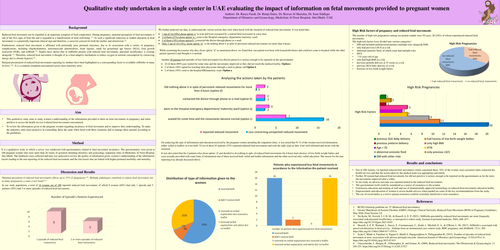
In our study population, a total of 14 women out of 100 reported reduced fetal movements of which 9 women (64%) had only 1 episode and 5 patients (36%) had 2 or more episodes of reduced fetal movements.
We further analyzed our data, to understand the various actions they took when faced with the situation of reduced fetal movements. It was noted that;
•7 out of 14 (50%) chose option ‘a’ to wait and were reassured by a normal fetal movement in some time.
•3 of them (21%) chose option ‘b’- went to the Hospital emergency department/ maternity ward.
•2 of them (14%) chose option c’ -contacted the doctor through phone or e-mail
•Only 2 out of 14 (14%) who had reduced fetal movements chose option ‘d’- to do nothing about it in spite of persistent reduced movements for more than 4 hours.
While examining the reasons why they chose option “d” as mentioned above, we found that; one patient was busy with household chores and could not come to hospital while the other patient ignored it and thought it is normal.
Another 20 patients had episodes of less fetal movements but did not perceive it serious enough to be reported on the questionnaire.
•16 of them (80%) just waited for some time and the movements improved so they did not reach the medical facility. Option c
•2 of them (10%) opted for reaching their physicians through e-mail or phone call Option b
•2 of them (10%) went to the hospital ER/maternity ward. Option a