1,830 posters, 67 videos, 75 audios, 29 topics, 22 sessions, 4,727 authors, 1,697 institutions
ePostersLive by SciGen Technologies S.A. All rights reserved.
RCOG World Congress 2023
June 12 - 14, 2023 | London, UK

EP.1249
An Audit of Inductions of Labour at Aneurin Bevan University Health Board
Poster Presenter
Authors
Affiliations
Part of Topic
High Risk Pregnancy
An Audit of the Inductions of Labour at Aneurin Bevan University Health Board
Objective:
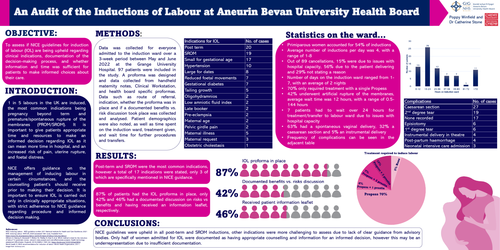
To assess if NICE guidelines for induction of labour (IOL) are being upheld regarding clinical indications, documentation of the decision-making process, and whether information and time was sufficient for patients to make informed choices about their care.
Introduction:
1 in 5 labours in the UK are induced, the most common indications being pregnancy beyond term and premature/spontaneous rupture of the membranes (PROM/SROM). It is important to give patients appropriate time and resources to make an informed decision regarding IOL as it can mean more time in hospital, and an increased risk of pain, uterine rupture, and foetal distress.
NICE offers guidance on the management of inducing labour in certain circumstances, and the counselling patient’s should receive prior to making their decision. It is important to ensure IOL is carried out only in clinically appropriate situations, with strict adherence to NICE guidance regarding procedure and informed decision making.
Methods:
Data was collected for everyone admitted to the induction ward over a 3-week period between May and June 2022 at the Grange University Hospital. 97 patients were included in the study. A proforma was designed and data collected from handheld maternity notes, Clinical Workstation, and health board specific proformas. Data such as route of referral, indication, whether the proforma was in place and if a documented benefits vs. risk discussion took place was collected and analysed. Patient demographics were also noted, as well as time spent on the induction ward, treatment given, and wait time for further procedures and transfers.
Results:
Post-term and SROM were the most common indications, however a total of 17 indications were stated, only 3 of which are specifically mentioned in NICE guidance.
87% of patients had the IOL proforma in place, only 42% and 46% had a documented discussion on risks vs benefits and having received an information leaflet, respectively.
NICE guidelines were upheld in all post-term and SROM inductions, other indications were more challenging to assess due to lack of clear guidance from advisory bodies. Only half of women admitted for IOL were documented as having appropriate counselling and information for an informed decision, however this may be an underrepresentation due to insufficient documentation.