1,830 posters, 67 videos, 75 audios, 29 topics, 22 sessions, 4,727 authors, 1,697 institutions
ePostersLive by SciGen Technologies S.A. All rights reserved.
RCOG World Congress 2023
June 12 - 14, 2023 | London, UK

EP.1248
An observational study on maternal & fetal outcome in heart disease complicating pregnancy
Poster Presenter
Authors
Affiliations
Part of Topic
High Risk Pregnancy
An observational study on the Maternal and Fetal outcome in heart disease complicating pregnancy in Tertiary care center in
Chennai, India
Dr. Roshini Arunaa MBBS MS OG, Dr. Geetha Ezhilrajan MD DGO DNB, Dr. M. Mahalakshmi MBBS, MS OG, MRCOG
INTRODUCTION:
Cardiovascular abnormalities are considered to be the most common
indirect obstetric cause of morbidity. The primary objective of the
present study is to assess the effect of heart diseases in pregnancy
and its outcome. An early diagnosis with multidisciplinary team
collaboration of trained obstetrician, cardiologist, anesthetist,
pediatrician and nurse results in a successful outcome for mother and
child in majority of cases. “Birthing is the most profound initiation
to spirituality a woman can have”. Hemodynamic changes that
occur physiological in pregnancy can result in maternal and fetal
morbidity. In mothers with heart disease, maternal inability to adapt to
these physiological changes can expose underlying, previously silent,
cardiac pathology, which is why some call pregnancy nature’s stress
test..
AIM:
• The primary objective of the study is to assess the effect of heart
diseases on pregnancy and its outcome on maternal and neonatal
morbidity and mortality.
• Early detection, intervention and effective management of heart
disease among pregnant women.
• ECHO screening among adolescent girls through school health
programs to diagnose cardiac diseases even before pregnancy.
METHODOLOGY:
The study was carried out in a tertiary care centre in Chennai, India
over the period Jan 2022- November 2022. All antenatal patients
having cardiac diseases either previously diagnosed or diagnosed
during antenatal visits, referrals with cardiac diseases, emergency
admissions, patients who developed cardiac complications during
peripartum period were included in the study. Data was statistically
analysed with KOBO. The etiological type of heart disease and
maternal and neonatal outcome were evaluated.
Detailed history of cardiovascular examination was performed to determine
the type of lesion, patient suspected of cardiac lesions were evaluated by
cardiologist to diagnose specific cardiac lesions. Risk assessment done
with functional status (NYHA class III or IV) or cyanosis, Left ventricular
systolic dysfunction (Ejection fraction < 0.40), Left heart obstruction (Mitral
valve area <2.0 cm2, aortic valve area < 1.5 cm2, or peak left ventricular
outflow tract gradient > 30 mm Hg) A cardiac event (Arrhythmia, stroke,
transient ischemic attack, or pulmonary oedema).
RESULTS:
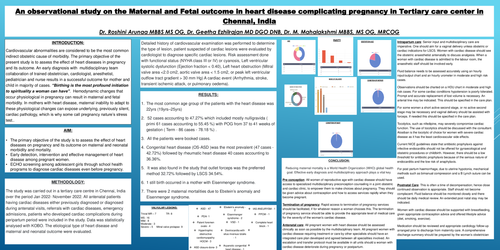
1. The most common age group of the patients with the heart disease was
22yrs (19yrs–25yrs)
2. 52 cases accounting to 47.27% which included mostly nulligravida (
primi 61 cases accounting to 55.45 %) with POG from 37 to 41 weeks of
gestation ( Term - 86 cases - 78.18 %) .
3. All the patients were booked cases.
4. Congenital heart disease (OS-ASD )was the most prevalent (47 cases -
42.72%) followed by rheumatic heart disease 40 cases accounting to
36.36%.
5. It was also found in the study that outlet forceps was the preferred
method 32.72% followed by LSCS 34.54%.
6. 1 still birth occurred in a mother with Eisenmenger syndrome.
7. There were 2 maternal mortalities due to Ebstein’s anomaly and
Eisenmenger syndrome.
VALVULAR LESIONS:
Trivial MR – 7 TR- 8
MS : 16
Mild - 8
Moderate - 3
Severe – 5 Mitral valve prolapse- 9
ASD - 47
Ebstein’s anomaly -
2
IAS ANEURYSM - 1
PDA- 1
Eisenmenger
syndrome - 2
PPCM - 1
Patent foremen
ovale - 4
VSD - 1 Complete heart
block - 1
Hypertrophic
obstructive
cardiomyopathy
HOCM - 3
Dextrocardia with
situs inversus totalis
- 1
ASD closure done- 3
Acyanotic congenital
heart disease - 1
Intrapartum care: Senior input and multidisciplinary care are
imperative. One should aim for a vaginal delivery unless obstetric or
cardiac indications for LSCS. Women with cardiac disease should see
the obstetric anaesthetist antenatally to discuss analgesia. When a
woman with cardiac disease is admitted to the labour room, the
anaesthetic staff should be involved early.
Fluid balance needs to be assessed accurately using an hourly
input/output chart and an hourly urometer in moderate and high risk
cases.
Observations should be charted on a HDU chart in moderate and high
risk cases. For some cardiac conditions hypotension is poorly tolerated.
Prompt and accurate replacement of lost volume is necessary. An
arterial line may be indicated. This should be specified in the care plan.
For some women a short active second stage, or no active second
stage may be necessary and vaginal delivery should be assisted with
forceps. If needed this should be specified in the care plan.
Tocolytics, such as nifedipine, may severely compromise cardiac
function. The use of tocolytics should be discussed with the consultant.
Atosiban is the tocolytic of choice for women with severe cardiac
disease as it has the least cardiovascular side effects.
Current NICE guidelines state that antibiotic prophylaxis against
infective endocarditis should not be offered for gynaecological and
obstetric procedures or childbirth. However, there should be a low
threshold for antibiotic prophylaxis because of the serious nature of
endocarditis and the low risk of anaphylaxis.
For post partum haemorrhage, due to uterine hypotonia, mechanical
methods such as bimanual compression and a B Lynch suture can be
used.
Postnatal Care: This is often a time of decompensation; hence close
continued observation is appropriate. Staff should not become
complacent. Fluid balance should be monitored closely and there
should be daily medical review. An extended post natal stay may be
indicated.
Women with cardiac disease should be supported with breastfeeding,
given appropriate contraception advice and offered lifestyle advice
(diet, smoking, exercise).
Medication should be reviewed and appropriate cardiology follow-up
arranged prior to discharge from maternity care. A comprehensive
discharge summary should be prepared by the woman’s obstetrician
CONCLUSION:
Reducing maternal mortality is a World Health Organization (WHO) global health
goal. Effective early diagnosis and multidisciplinary approach plays a vital key.
Pre conception: All women of reproductive age with cardiac disease should have
access to specialized multidisciplinary preconception counseling in a joint obstetric
and cardiac clinic, to empower them to make choices about pregnancy. They should
be given advice about contraception and how to access services rapidly when they
become pregnant.
Termination of pregnancy: Rapid access to termination of pregnancy services
should be facilitated, if for whatever reason a woman chooses this. The termination
of pregnancy service should be able to provide the appropriate level of medical care
for the severity of the woman’s cardiac disease.
Antenatal care: All pregnant women with heart disease should be assessed
clinically as soon as possible by the multidisciplinary team. All pregnant women with
cardiac disease requiring treatment or care by other specialists should have an
integrated care plan developed and agreed between all specialities involved. An
escalation and transfer protocol must be available in all units should a woman with
cardiac disease deteriorate during pregnancy or postpartum.