1,830 posters, 67 videos, 75 audios, 29 topics, 22 sessions, 4,727 authors, 1,697 institutions
ePostersLive by SciGen Technologies S.A. All rights reserved.
RCOG World Congress 2023
June 12 - 14, 2023 | London, UK

EP.1242
Impact of cannabinoids on fertility; a review
Poster Presenter
Part of Topic
Hot Topics (Emerging research/issues) in Gynaecology
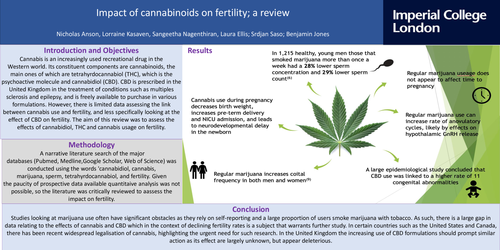
Objective: Cannabis is an increasingly used recreational drug in the western world. Its constituent components are cannabinoids, the main ones of which aretetrahyrdocannabiol (THC), which is the psychoactive molecule and cannabidiol (CBD). CBD isprescribed in the United Kingdom in the treatment of conditions such as multiple sclerosis andepilepsy, and is freely available to purchase in various forumations.However, there is limiteddata assessing the link between cannabis use and fertility, and less specifically looking at the effect of CBD on fertility. The objective of this study was treviewthe effects of cannabidiol, THC and cannabis usage on fertility.
Methods: A narrative literature search of the major databases (Pubmed, Medline,Google Scholar, Web of Science) was conducted using the words ‘cannabidiol, cannabis, marijuana, sperm, tetrahyrdocannabiol, and fertility’. Given the paucity of prospective data available quantitative analysis was not possible, sothe literature was critically reviewedto assess the impact on fertility.
Results: Cannabis usage appears to negatively impactovulation,as well assemen parameters, including sperm count, concentration, morphology, motility, how this relates to conception is less well established with contrasting findings between studies. The data available for late pregnancy and neonatal outcomes is better established with a detrimental effect found with cannabis usage during pregnancy.
Conclusions: There is a large gap in data relating to the effects of cannabis and CBD which in the context of declining fertility rates is a subject that warrants further study. In certain countries such as the United States and Canada there has been recent widespread legalisation of cannabis, highlighting the urgent need for such research. In the United Kingdom the increasing use of CBD formulations should prompt similar action as its effect are largely unknown, but appear deleterious.
References:
(1) Schilling S, Melzer R, McCabe PF. Cannabis sativa. Curr Biol. 2020 Jan 6;30(1):R8-R9. doi: 10.1016/j.cub.2019.10.039. PMID: 31910378.
(2) Fonseca BM, Rebelo I. Cannabis and Cannabinoids in Reproduction and Fertility: Where We Stand. Reprod Sci. 2022 Sep;29(9):2429-2439. doi: 10.1007/s43032-021-00588-1. Epub 2021 May 10. PMID: 33970442.
(3) Office for National Statistics, Drug Misuse in England and Wales: year ending March 2020. 9th December 2022.
(4) Green shoots: Sowing the seeds of the new UK cannabinoid market. Association for the Cannabinoid industry. The centre for medical cannabis. https://theaci.co.uk/wp-content/uploads/2021/05/Green-shoots-Sowing-the-seeds-of-the-new-UK-cannabis-market-ACI-_-CMC-report.pdf
(5) Hodges c, Bhatarah P, Gibbs B. The Hodges Review, From Containment To Nurturing: How the UK can become a world lewder in cannabinoid innovation. June 2022.
(6) Gundersen TD, Jørgensen N, Andersson AM, Bang AK, Nordkap L, Skakkebæk NE, Priskorn L, Juul A, Jensen TK. Association Between Use of Marijuana and Male Reproductive Hormones and Semen Quality: A Study Among 1,215 Healthy Young Men. Am J Epidemiol. 2015 Sep 15;182(6):473-81. doi: 10.1093/aje/kwv135. Epub 2015 Aug 16. PMID: 26283092.
(7) Kasman AM, Thoma ME, McLain AC, Eisenberg ML. Association between use of marijuana and time to pregnancy in men and women: findings from the National Survey of Family Growth. Fertil Steril. 2018 May;109(5):866-871. doi: 10.1016/j.fertnstert.2018.01.015. Epub 2018 Mar 16. PMID: 29555335.
(8) Jukic AM, Weinberg CR, Baird DD, Wilcox AJ. Lifestyle and reproductive factors associated with follicular phase length. J Womens Health (Larchmt). 2007 Nov;16(9):1340-7. doi: 10.1089/jwh.2007.0354. PMID: 18001191; PMCID: PMC2834565.
(9) Sun AJ, Eisenberg ML. Association Between Marijuana Use and Sexual Frequency in the United States: A Population-Based Study. J Sex Med. 2017 Nov;14(11):1342-1347. doi: 10.1016/j.jsxm.2017.09.005. PMID: 29110804.
(10) Reece AS, Hulse GK. Geotemporospatial and causal inference epidemiological analysis of US survey and overview of cannabis, cannabidiol and cannabinoid genotoxicity in relation to congenital anomalies 2001-2015. BMC Pediatr. 2022 Jan 19;22(1):47. doi: 10.1186/s12887-021-02996-3. PMID: 35042455; PMCID: PMC8767720.
(11) Iezzi D, Caceres-Rodriguez A, Chavis P, Manzoni OJJ. In utero exposure to cannabidiol disrupts select early-life behaviors in a sex-specific manner. Transl Psychiatry. 2022 Dec 5;12(1):501. doi: 10.1038/s41398-022-02271-8. PMID: 36470874; PMCID: PMC9722662.
(12) Miranda CC, Barata T, Vaz SH, Ferreira C, Quintas A, Bekman EP. hiPSC-Based Model of Prenatal Exposure to Cannabinoids: Effect on Neuronal Differentiation. Front Mol Neurosci. 2020 Jul 6;13:119. doi: 10.3389/fnmol.2020.00119. PMID: 32733202; PMCID: PMC7357827.
(13) Alves P, Amaral C, Teixeira N, Correia-da-Silva G. Cannabidiol disrupts apoptosis, autophagy and invasion processes of placental trophoblasts. Arch Toxicol. 2021 Oct;95(10):3393-3406. doi: 10.1007/s00204-021-03122-z. Epub 2021 Jul 24. PMID: 34302491.
(14) Carvalho RK, Souza MR, Santos ML, Guimarães FS, Pobbe RLH, Andersen ML, Mazaro-Costa R. Chronic cannabidiol exposure promotes functional impairment in sexual behavior and fertility of male mice. Reprod Toxicol. 2018 Oct;81:34-40. doi: 10.1016/j.reprotox.2018.06.013. Epub 2018 Jun 21. PMID: 29936126.