1,830 posters, 67 videos, 75 audios, 29 topics, 22 sessions, 4,727 authors, 1,697 institutions
ePostersLive by SciGen Technologies S.A. All rights reserved.
RCOG World Congress 2023
June 12 - 14, 2023 | London, UK

EP.1241
Cervical cytological abnormalities in women living with Human Immunodeficiency Virus in Jamaica
Poster Presenter
Authors
Carole Rattray, Lana Chung, Ian Bambury, Kathy-Ann PateRobinson, Shaun Wynter, Natalie Medley
Affiliations
Part of Topic
Gynae Oncology
Cervical cytological abnormalities in women living with human immunodeficiency virus in Jamaica
Carole Rattray, Lana Chung, Ian Bambury, Kathy-Ann Pate-Robinson, Shaun Wynter, Natalie Medley
INTRODUCTION
Cervical cancer is the second leading cause of female cancer and cancer-related deaths in
Jamaica with about 486 cases diagnosed annually, a crude age-standardized rate of 15.7/100,000
per year (1). Women living with HIV (WLHIV) are at increased risk of persistent HPV infection,
precancerous lesions and are 5 to 6 times more likely to develop cervical cancer (2).
This study was performed to determine the prevalence of pap smear abnormalities and associated
risk factors among WLHIV attending the Centre for HIV/AIDS Research, Education & Services
(CHARES) in Kingston Jamaica with the intention to treat, educate, and bring awareness to the
value of screening.
RESEARCH QUESTION
Is there an increased risk of cytological abnormalities in women living with HIV ?
What are the risk factors for cytological abnormalities in women living with HIV?
METHODS
This was a convenience sample of WLHIV & accessing HIV/AIDS services
Data Collection
• Self-administered structured questionnaire
• Conventional pap smear taken
Chart Review
• Demographics, Latest CD4 count, Latest viral Load
• Level of drug compliance
Data Analysis
• Univariate analyses using means, medians, or frequencies
• Bivariate analyses using the student t-test for differences in CD4 counts and viral loads
• Chi-square tests were used for associations
• Multivariate analysis was done to evaluate for risk factors.
A p-value of < 0.05 was considered statistically significant.
RESULTS
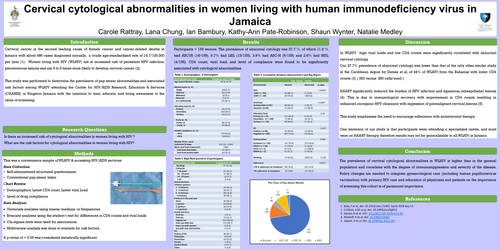
Participants = 155 women. The prevalence of abnormal cytology was 27.7 %, of which 11.6 %
had ASCUS (18/155), 9.7% had LSIL (15/155), 3.9% had ASC-H (6/155) and 2.6% had HSIL
(4/155). CD4+ count, viral load, and level of compliance were found to be significantly
associated with cytological abnormalities.
DISCUSSION
In WLHIV, high viral loads and low CD4 counts were significantly correlated with abnormal
cervical cytology.
Our 27.7% prevalence of abnormal cytology was lower than that of the only other similar study
in the Caribbean region by Dames et al. of 44% of WLHIV from the Bahamas with lower CD4
counts (3) ( 553 versus 260 cells/mm3 ).
HAART significantly reduced the burden of HPV infection and squamous intraepithelial lesions
(4). This is due to immunological recovery with improvement in CD4 counts resulting in
enhanced oncogenic HPV clearance with regression of premalignant cervical lesions (5).
This study emphasises the need to encourage adherence with antiretroviral therapy.
One limitation of our study is that participants were attending a specialized centre, and most
were on HAART therapy, therefore results may not be generalizable to allWLHIV in Jamaica
CONCLUSION
The prevalence of cervical cytological abnormalities in WLHIV is higher than in the general
population and correlates with the degree of immunosuppression and severity of the disease.
Policy changes are needed to integrate gynaecological care (including human papillomavirus
vaccination) with primary HIV care and education of physicians and patients on the importance
of screening this cohort is of paramount importance.