1,830 posters, 67 videos, 75 audios, 29 topics, 22 sessions, 4,727 authors, 1,697 institutions
ePostersLive by SciGen Technologies S.A. All rights reserved.
RCOG World Congress 2023
June 12 - 14, 2023 | London, UK

EP.1231
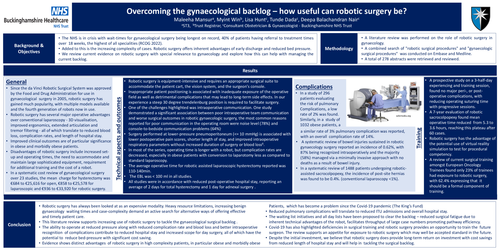
Overcoming the gynaecological backlog – how useful can robotic surgery be?
Poster Presenter
Authors
Maleeha Mansur, Myint Win, Lisa Hunt, Tunde Dada, Deepa Balachandrannair
Affiliations
Part of Topic
Hot Topics (Emerging research/issues) in Gynaecology
Overcoming the gynaecological backlog – how useful can robotic surgery be?
Maleeha Mansura, Myint Winb, Lisa Huntc, Tunde Dadac, Deepa Balachandran Nairc
aST3, bTrust Registrar, cConsultant Obstetrician & Gynaecologist - Buckinghamshire NHS Trust
Background & Objectives
General
by the Food and Drug Administration for use in
gynaecological surgery in 2005, robotic surgery has
gained much popularity, with multiple models available
and the fourth generation of robots now in use.
over conventional laparoscopy - 3D visualisation,
improved ergonomics, extended articulation and
tremor filtering - all of which translate to reduced blood
loss, complication rates, and length of hospital stay.
in obese and morbidly obese patients.
up and operating times, the need to accommodate and
maintain large sophisticated equipment, requirement
for additional training and the cost of a robot.
over 23 studies, the mean charge for hysterectomy was
€684 to €25,616 for open, €858 to €25,578 for
laparoscopic and €936 to €33,920 for robotic surgery.
Technical aspects and outcomes
accommodate the patient cart, the vision system, and the surgeon's console.
field as well as detrimental complications that may lead to long-term side effects. In our
experience a steep 30 degree trendelenburg position is required to facilitate surgery.
demonstrated a significant association between poor intraoperative team communication
and worse surgical outcomes in robotic gynaecologic surgery, the most common reasons
reported for poor communication in the operating room were noise level (78%) and
console-to-bedside communication problems (64%).
lower postoperative pain scores, shorter length of stay, and improved intraoperative
respiratory parameters without increased duration of surgery or blood loss6.
decreased, especially in obese patients with conversion to laparotomy less as compared to
standard laparoscopy.
110-140min.
average of 2 days for total hysterectomy and 1 day for adnexal surgery .
Complications
patients evaluating
the risk of pulmonary
Complications, a low
rate of 2% was found.
Similarly, in a study of
1032 obese patients, a
a similar rate of 3% pulmonary complication was reported,
with an overall complication rate of 14%.
gynaecology surgery reported an incidence of 0.62%, with
87% being recognized intraoperatively and the majority
(58%) managed via a minimally invasive approach with no
deaths as a result of bowel injury.
assisted sacrocolpopexy, the incidence of post-site hernias
was found to be 0.4%. (conventional laparoscopy <1%).
Training
experiencing and training session,
found no major peri-, or post-
operative complications, with
reducing operating suturing time
with progressive sessions.
sacrocolpopexy found mean
operative time reduced from 5.3 to
3.6 hours, reaching this plateau after
60 cases.
the potential use of virtual reality
simulation to test for procedural
competency.
amongst European Oncology
Trainees found only 23% of trainees
had exposure to robotic surgery,
with 62.4% expressing that it
should be a formal component of
training.5
Conclusion
gynaecology waiting times and case-complexity demand an active search for alternative ways of offering effective
and timely patient care.
recognition of complications contribute to reduced hospital stay and increased scope for day surgery, all of which have the
potential to reduce bed-pressure with significant cost saving.
Patients, which has become a problem since the Covid-19 pandemic (The King’s Fund)
inherent technical advantages of the robot, facilitates throughput of large case numbers promoting pathway efficiency.
surgeon. The review supports an appetite for exposure to robotic surgery which may well be accepted standard in the future.
from reduced length of hospital stay and will help in tackling the surgical backlog.