1,830 posters, 67 videos, 75 audios, 29 topics, 22 sessions, 4,727 authors, 1,697 institutions
ePostersLive by SciGen Technologies S.A. All rights reserved.
RCOG World Congress 2023
June 12 - 14, 2023 | London, UK

EP.1221
Public perspective on uses and indications of surrogacy in Sri Lanka.
Poster Presenter
Authors
Dulanji Beneragama, Akhila Munasinghe, Lakindu Grero, Janani Withana, Janith Gamage, Shamini Prathapan, Ramya Pathiraja
Affiliations
Faculty of Medical Sciences, University of Sri Jayewardenepura, Sri Lanka, Department of Community Medicine, Faculty of Medical Sciences, University of Sri Jayewardenepura, Sri Lanka., Department of Obstetrics and Gynecology, Faculty of Medical Sciences, University of Sri Jayewardenepura, Sri Lanka
Part of Topic
Reproductive Medicine/Assisted Reproduction
Public perspective on uses and indications of surrogacy in Sri Lanka.
Gamage TGJN1, Beneragama DM1, Grero KLW1, Munasinghe MAA1, Withana JL1, Pathiraja RP2, Prathapan S3
1Faculty of Medical Sciences, University of Sri Jayewardenepura, Sri Lanka; 2Department of Obstetrics and Gynecology, Faculty of Medical Sciences, University of Sri Jayewardenepura, Sri Lanka; 3Department of Community Medicine, Faculty of Medical Sciences, University of Sri Jayewardenepura, Sri Lanka.
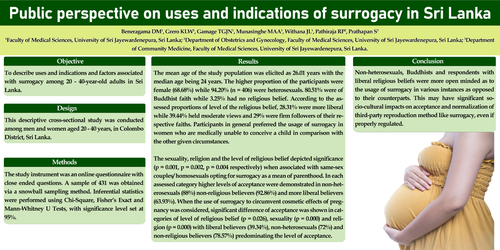
Objective: To describe uses and indications and factors associated with surrogacy among 20 - 40-year-old adults in Sri Lanka.
Design: This descriptive cross-sectional study was conducted among men and women aged 20 - 40 years, in Colombo District, Sri Lanka.
Methods: The study instrument was an online questionnaire with close ended questions. A sample of 431 was obtained via a snowball sampling method. Inferential statistics were performed using Chi-Square, Fisher’s Exact and Mann-Whitney U Tests, with significance level set at 95%.
Results: The mean age of the study population was elicited as 26.01 years with the median age being 24 years. The higher proportion of the participants were female (68.68%) while 94.20% (n = 406) were heterosexuals. 80.51% were of Buddhist faith while 3.25% had no religious belief. According to the assessed proportions of level of the religious belief, 28.31% were more liberal while 39.44% held moderate views and 29% were firm followers of their respective faiths. Participants in general preferred the usage of surrogacy in women who are medically unable to conceive a child in comparison with the other given circumstances. The sexuality, religion and the level of religious belief depicted significance (p = 0.001, p = 0.002, p = 0.004 respectively) when associated with same-sex couples/ homosexuals opting for surrogacy as a mean of parenthood. In each assessed category higher levels of acceptance were demonstrated in non-heterosexuals (88%) non-religious believers (92.86%) and more liberal believers (63.93%). When the use of surrogacy to circumvent cosmetic effects of pregnancy was considered, significant difference of acceptance was shown in categories of level of religious belief (p = 0.026), sexuality (p = 0.000) and religion (p = 0.000) with liberal believers (39.34%), non-heterosexuals (72%) and non-religious believers (78.57%) predominating the level of acceptance.
Conclusion: Non-heterosexuals, Buddhists and respondents with liberal religious beliefs were more open minded as to the usage of surrogacy in various instances as opposed to their counterparts. This may have significant socio-cultural impacts on acceptance and normalization of third-party reproduction method like surrogacy, even if properly regulated.