1,830 posters, 67 videos, 75 audios, 29 topics, 22 sessions, 4,727 authors, 1,697 institutions
ePostersLive by SciGen Technologies S.A. All rights reserved.
RCOG World Congress 2023
June 12 - 14, 2023 | London, UK

EP.1220
Implementing a grab box to manage uterine inversion in the labour ward
Poster Presenter
Authors
Affiliations
Part of Topic
Labour Ward Management
Audio
Title:
Implementing a grab box for the management of uterine inversion in the labour ward
Introduction:
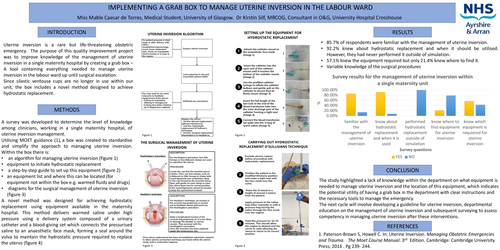
Uterine inversion is a rare but life-threatening obstetric emergency. The purpose of this quality improvement project was to improve knowledge of the management of uterine inversion in a single maternity hospital by creating a grab box – A tool containing everything needed to manage uterine inversion in the labour ward up until surgical escalation.
Since silastic ventouse cups are no longer in use within our unit, the box includes a novel method designed to achieve hydrostatic replacement
Methods:
A survey was developed to determine the level of knowledge among clinicians, working in a single maternity hospital, of uterine inversion management.
Utilising MOET guidance (1), a box was created to standardise and simplify the approach to managing uterine inversion. Within the box there is:
A novel method was designed for achieving hydrostatic replacement using equipment available in the maternity hospital. This method delivers warmed saline under high pressure using a delivery system composed of a urinary catheter and a blood-giving set which connects the pressurised saline to an anaesthetic face mask, forming a seal around the vulva to maintain the hydrostatic pressure required to replace the uterus (figure 4)
Results:
The study highlighted a lack of knowledge within the department on what equipment is needed to manage uterine inversion and the location of this equipment, which indicates the potential utility of having a grab box in the department with clear instructions and the necessary tools to manage the emergency.
The next cycle will involve developing a guideline for uterine inversion, departmental education on the management of uterine inversion and subsequent surveying to assess competency in managing uterine inversion after these interventions.
1. Paterson-Brown S, Howell C. In: Uterine Inversion. Managing Obstetric Emergencies and Trauma. The Moet Course Manual. 3rd Edition. Cambridge: Cambridge University Press; 2016 . Pg 239- 244.