1,830 posters, 67 videos, 75 audios, 29 topics, 22 sessions, 4,727 authors, 1,697 institutions
ePostersLive by SciGen Technologies S.A. All rights reserved.
RCOG World Congress 2023
June 12 - 14, 2023 | London, UK

EP.1214
Causes, management, and outcomes of postpartum haemorrhage: a single-centre study
Poster Presenter
Authors
Sophie Bracke, Mohamed Ragab, Rebecca Allen, Zaib-Un-Nisa Raja
Affiliations
Part of Topic
Labour Ward Management
Causes, management, and outcomes of postpartum haemorrhage: a single-centre study
Sophie Bracke1, Mohamed Ragab1, Rebecca Allen1, Zaib-Un-Nisa Raja1
1 Whipps Cross Hospital, London
Introduction
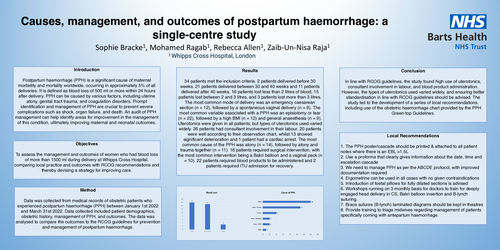
Postpartum haemorrhage (PPH) is a significant cause of maternal morbidity and mortality worldwide, occurring in approximately 5% of all deliveries. It is defined as blood loss of 500 ml or more within 24 hours after delivery. PPH can be caused by various factors, including uterine atony, genital tract trauma, and coagulation disorders. Prompt identification and management of PPH are crucial to prevent severe complications such as shock, organ failure, and death. An audit of PPH management can help identify areas for improvement in the management of this condition, ultimately improving maternal and neonatal outcomes.
Objectives
To assess the management and outcomes of women who had blood loss of more than 1500 ml during delivery at Whipps Cross Hospital, comparing local practice and outcomes with RCOG recommendations and thereby devising a strategy for improving care.
Method
Data was collected from medical records of obstetric patients who experienced postpartum haemorrhage (PPH) between January 1st 2022 and March 31st 2022. Data collected included patient demographics, obstetric history, management of PPH, and outcomes. The data was analysed to compare the outcomes to the RCOG guidelines for prevention and management of postpartum haemorrhage.
Results
34 patients met the inclusion criteria. 2 patients delivered before 30 weeks, 21 patients delivered between 30 and 40 weeks and 11 patients delivered after 40 weeks. 16 patients lost less than 2 litres of blood, 15 patients lost between 2 and 3 litres, and 3 patients lost more than 3 litres. The most common mode of delivery was an emergency caesarean section (n = 12), followed by a spontaneous vaginal delivery (n = 9). The most common variable associated with a PPH was an episiotomy or tear (n = 22), followed by a high BMI (n = 12) and general anaesthesia (n = 9). Uterotonics were given in all patients, but types of uterotonics used varied widely. 26 patients had consultant involvement in their labour. 20 patients were well according to their observation chart, whilst 13 showed significant deterioration and 1 patient had a cardiac arrest. The most common cause of the PPH was atony (n = 14), followed by atony and trauma together (n = 11). 16 patients required surgical intervention, with the most common intervention being a Bakri balloon and a vaginal pack (n = 10). 22 patients required blood products to be administered and 2 patients required ITU admission for recovery.
Conclusion
In line with RCOG guidelines, the study found high use of uterotonics, consultant involvement in labour, and blood product administration. However, the types of uterotonics used varied widely, and ensuring better standardisation in line with RCOG guidelines should be advised. The study led to the development of a series of local recommendations, including use of the obstetric haemorrhage chart provided by the PPH Green-top Guidelines.
Local Recommendations
1. The PPH poster/cascade should be printed & attached to all patient notes where there is an EBL >1.5L