1,830 posters, 67 videos, 75 audios, 29 topics, 22 sessions, 4,727 authors, 1,697 institutions
ePostersLive by SciGen Technologies S.A. All rights reserved.
RCOG World Congress 2023
June 12 - 14, 2023 | London, UK

EP.0120
HIDDEN FIGURES: Defining vulnerable pregnant women and factors influencing their maternity care
Poster Presenter
Part of Topic
Hot Topics (Emerging research/issues) in Obstetrics
HIDDEN FIGURES: Defining vulnerable pregnant women and factors that influence their care
at University College London Hospital (UCLH) Adil, H.1,2, Pierce, P. 1,2, Whitten, M.2,3 and Hillman, S.2,3
1) University College London Medical School, Reach Alliance researcher,2) EGA Institute for Women's Health, UCL 3) University College London Hospitals NHS Foundation Trust
Introduction:
Vulnerable pregnant women have a greater likelihood of experiencing adverse pregnancy outcomes. The effects are far-reaching as they impact the mother, the children, and the family. Difficulties are seen in identifying and consequently, treating vulnerability. Antenatal care is crucial to ensure the best outcomes by allowing early recognition of vulnerability, management of safeguarding concerns and consequently intervention.
Aims:
-
Assess the different types of vulnerability faced in central London
-
Understand who is disengaged with antenatal care
-
Identify barriers to accessing and engaging with care
-
Consider staff experiences of delivering care to vulnerable individuals
Methods:
A mixed-methods approach was taken to consider how vulnerability manifests at UCLH and how it feels to care for vulnerable women. This consisted of both primary data collection including multiple datasets and surveys. Statistical and thematic analysis were conducted.
The attending and non-attending populations using demographic characteristics
Collate information on risk factors and prevalence of vulnerability markers
Safeguarding team cohort
Surveys to evaluate of staff and patient perspectives as key stakeholders
Results
-
21% of the general population was identified as vulnerable
-
80% of vulnerable women showed multiple indicators of
vulnerability
-
Risk factors of vulnerability were poor engagement with antenatal care, ethnic minority backgrounds, and complex social circumstances
-
Barriers in care from a staff perspective include language and cultural barriers, digital exclusion, lack of confidence and training to care for vulnerable groups
Results:
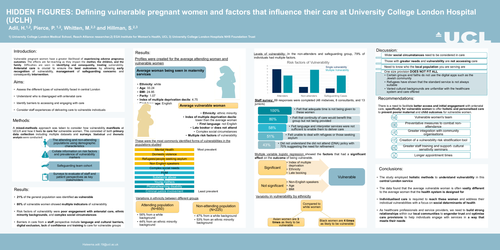
Profiles were created for the average attending woman and vulnerable women.
Average woman being seen in maternity services
• Ethnicity: white • Age: 33.24
• BMI: 24.95
• Parity: 1.07
• Index of multiple deprivation decile: 4.75 • First language: English
Average vulnerable woman
Ethnicity: ethnic minority
• Index of multiple deprivation decile: lower than the average woman
• First language: not English • Late booker or does not attend • Complex social circumstances • Multiple risk factors of vulnerability
These were the most commonly identified forms of vulnerabilities in the populations studied
Most prevalent
Mental Health Domestic violence Refugees/people seeking asylum Non English speakers Complex social needs FGM
Substance abuse
Young mothers Physical/learning disability Criminal justice involvement
Variations in ethnicity between different groups
Attending population (N=650)
• 56% from a white background
• 44% from an ethnic minority background
Non-attending population (N=225)
• 47% from a white background
• 53% from an ethnic minority background
Levels of vulnerability: In the non-attenders and safeguarding group, 79% of individuals had multiple factors.
Staff survey: 69 responses were completed (48 midwives, 8 consultants, and 13 juniors)
Multiple variable logistic regression showed the factors that had a significant effect on the outcome of being vulnerable.
Recommendations:
There is a need to facilitate better access and initial engagement with antenatal care, specifically for vulnerable women to offer holistic and personalised care to prevent poorer maternal and child outcomes for vulnerable women.
Conclusions::
• The study employed holistic methods to understand
vulnerability in this central London service
-
The data found that the average vulnerable woman is often vastly different to the average woman that the health system is designed for
-
Individualised care is required to reach these women and address their individual vulnerabilities with a focus on social determinants of health
-
As healthcare professionals and service providers, we need to build strong relationships within our local communities to engender trust and optimise care provisions to help individuals engage with services in a way that meets their needs