1,830 posters, 67 videos, 75 audios, 29 topics, 22 sessions, 4,727 authors, 1,697 institutions
ePostersLive by SciGen Technologies S.A. All rights reserved.
RCOG World Congress 2023
June 12 - 14, 2023 | London, UK

EP.1212
Massive hemorrhage in second trimester; a rare presentation of placenta percreta.
Poster Presenter
Authors
Nabila Arfah Mohd Yassin, Neha Sethi Naresh Sethi, Sofiah Sulaiman
Affiliations
Part of Topic
High Risk Pregnancy
Title: Massive hemorrhage in second trimester; a rare presentation of placenta percreta.
Authors: Nabila Arfah Mohd Yassin 1, Neha Sethi 1,Sofiah Sulaiman 1,
Affiliation: 1 Department of Obstetrics & Gynaecology, Faculty of Medicine Universiti Malaya, Kuala Lumpur, Malaysia
Introduction:
The rising rates of caesarean delivery has been associated with rapid surge of worldwide incidence of placenta accreta spectrum such as placenta percreta. Furthermore, the increasing number of previous caesarean section in a woman increases her risk to have placenta percreta. Therefore, it is imperative for obstetricians to diagnose placenta accreta spectrum. Reduction of maternal morbidity and mortality has been shown with proper antenatal care and management. However, if it remains undiagnosed placenta accreta spectrum could be life-threatening, resulting from catastrophic obstetric haemorrhage.
Objective:
We report here a case of massive hemorrhage in a second trimester miscarriage secondary to placenta percreta which required life-saving hysterectomy.
Method:
Case report
Results:
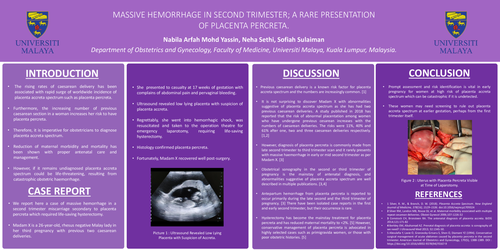
A 26-year-old rhesus negative woman in her third pregnancy with previous two caesarean deliveries presented to casualty at 17 weeks 1 day of gestation with complains of abdominal pain and pervaginal bleeding. Ultrasound revealed low lying placenta with suspicion of accreta. Regrettably, she was in hemorrhagic shock, resuscitated and taken to the operation theatre for emergency laparotomy, requiring life-saving hysterectomy. Histology confirmed placenta percreta. Patient recovered well post-surgery.
Conclusion:
Prompt assessment and risk identification is vital in early pregnancy for women at high risk of placenta percreta which can be catastrophic if it is undetected. These women may need screening to rule out placenta accreta spectrum at earlier gestation.