1,830 posters, 67 videos, 75 audios, 29 topics, 22 sessions, 4,727 authors, 1,697 institutions
ePostersLive by SciGen Technologies S.A. All rights reserved.
RCOG World Congress 2023
June 12 - 14, 2023 | London, UK

EP.1208
Management of endometriosis cases in a district general hospital
Poster Presenter
Authors
Affiliations
Part of Topic
Benign Gynaecology
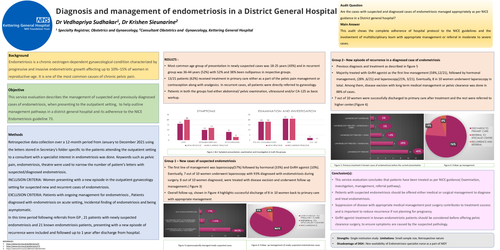
Diagnosis and management of endometriosis in a District General Hospital
Dr Vedhapriya Sudhakar1, Dr Krishen Sieunarine2
1 Specialty Registrar, Obstetrics and Gynaecology, 2Consultant Obstetrics and Gynaecology, Kettering General Hospital
Audit Question
Are the cases with suspected and diagnosed cases of endometriosis managed appropriately as per NICE guidance in a District general hospital?
Main Answer
This audit shows the complete adherence of hospital protocol to the NICE guidelines and the involvement of multidisciplinary team with appropriate management or referral in moderate to severe cases.
Background
Endometriosis is a chronic oestrogen-dependent gynaecological condition characterized by progressive and invasive endometriotic growth affecting up to 10%–15% of women in reproductive-age. It is one of the most common causes of chronic pelvic pain.
Objective
This service evaluation describes the management of suspected and previously diagnosed cases of endometriosis, when presenting to the outpatient setting, to help outline management pathways in a district general hospital and its adherence to the NICE Endometriosis guideline 73.
Methods
Retrospective data collection over a 12-month period from January to December 2021 using the letters stored in Secretary’s folder specific to the patients attending the outpatient setting to a consultant with a specialist interest in endometriosis was done. Keywords such as pelvic pain, endometriosis, theatre were used to narrow the number of patient’s letters with suspected/diagnosed endometriosis.
INCLUSION CRITERIA: Women presenting with a new episode in the outpatient gynaecology setting for suspected new and recurrent cases of endometriosis.
EXCLUSION CRITERIA: Patients with ongoing management for endometriosis , Patients diagnosed with endometriosis on acute setting, Incidental finding of endometriosis and being asymptomatic.
In this time period following referrals from GP , 21 patients with newly suspected endometriosis and 21 known endometriosis patients, presenting with a new episode of recurrence were included and followed up to 1 year after discharge from hospital.
RESULTS :
Group 1 – New cases of suspected endometriosis
Group 2– New episode of recurrence in a diagnosed case of endometriosis
Conclusion(s):