1,830 posters, 67 videos, 75 audios, 29 topics, 22 sessions, 4,727 authors, 1,697 institutions
ePostersLive by SciGen Technologies S.A. All rights reserved.
RCOG World Congress 2023
June 12 - 14, 2023 | London, UK

EP.1200
Knowledge and Attitude of Healthcare Professionals towards fertility preservation in Sub-Saharan Africa
Part of Topic
Reproductive Medicine/Assisted Reproduction
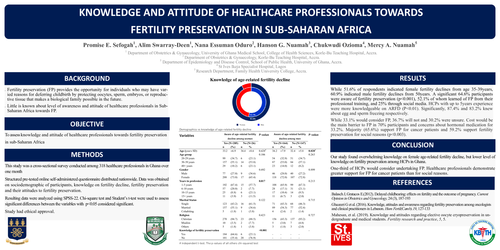
Background: Fertility preservation (FP) provides the opportunity for individuals who may have var-ied reasons for deferring childbirth by protecting oocytes, sperm, embryos, or reproduc-tive tissue that makes a biological family possible in the future. Little is known about level of awareness and attitude of healthcare professionals in Sub-Saharan Africa towards FP.
Methods: This study was a cross-sectional survey conducted among 318 healthcare professionals in Ghana over one month
Structured pre-tested online self-administered questionnaire distributed nationwide. Data was obtained on sociodemographic of participants, knowledge on fertility decline, fertility preservation and their attitudes to fertility preservation.
Resulting data were analyzed using SPSS-22. Chi-square test and Student’s t-test were used to assess significant differences between the variables with p<0.05 considered significant. Study had ethical approval.
Results: While 51.6% of respondents indicated female fertility declines from age 35-39years, 60.9% indicated male fertility declines from 50years. A significant 64.6% participants were aware of fertility preservation (p<0.001), 52.1% of whom learned of FP from their professional training, and 25% through social media. HCPs with up to 5years experience were more knowledgeable on ARFD (P<0.01). Significantly, 87.4% and 83.2% knew about egg and sperm freezing respectively.
While 33.1% would consider FP, 36.7% will not and 30.2% were unsure. Cost would be the main barrier to FP in 70% participants and concerns about hormonal medication for 33.2%. Majority (65.6%) support FP for cancer patients and 59.2% support fertility preservation for social reasons (p<0.003).
Conclusion:Our study found overwhelming knowledge on female age-related fertility decline, but lower level of knowledge on fertility preservation among HCPs in Ghana. One-third of HCPs would consider undertaking FP. Healthcare professionals demonstrate greater support for FP for cancer patients than for social reasons.