1,830 posters, 67 videos, 75 audios, 29 topics, 22 sessions, 4,727 authors, 1,697 institutions
ePostersLive by SciGen Technologies S.A. All rights reserved.
RCOG World Congress 2023
June 12 - 14, 2023 | London, UK

EP.1196
Absentee husbands dealing with fertility issues
Poster Presenter
Authors
Affiliations
Part of Topic
Reproductive Medicine/Assisted Reproduction
Title: Absentee Husband Dealing With Fertility Issues
Authors: Mafruha khanam1, Md Yousuf Solaiman Khan2
1. Fertility and IVF Specialist, Surgiscope Fertility Centre(SFC); 2. Medical Officer, SFC.
Introduction:
The global infertility rates are increasing at an alarming pace. The ascending rates of infertility is of global concern, affecting approximately 8-12% of couples world-wide1-3. The majority of women experience some form of reproductive disorder over the course of life as well as many chronic diseases and the absence of their husband makes the scenario more complicated. Absentee husband and their fertility issues have remained an unresolved problem for infertility specialists. Infertility is characterized as the failure to establish a clinical pregnancy after one year or more despite having regular unprotected coitus². There are two types, primary and secondary infertility.
Previously, infertility was considered to be a female incompetence, but recent data has shown that a male factor is solely responsible in about 20% of infertile couples and contributory in another 30-40%.
Objectives:
The objective of our study is to find out the reproductive outcome of husbands living at home and abroad and compare them.
Materials and Methods:
This cross-sectional prospective study was carried out over 2 years and 6 months between June, 2020 and November, 2022 at Surgiscope fertility Centre, Chattogram, Bangladesh among 200 couples. The data included answers to objective specified questionnaire, history and semen analysis reports of male partners. Inclusion criteria were all absentee husband (who lives abroad), husbands who had tried for conception for at least 1 or more year and husband who has done Semen Analysis. Criteria of exclusion are couples who have not continued infertility treatment for at least 6 months, husbands whose FNAC report reveals no spermatogenesis.
Statistical Analysis:
The variables selected were: patient para-meters like- age of patient, age of wife, duration of togetherness, conception, level of education. Parameters related to semen analysis include seminal appearance, seminal liquefaction time, seminal consistency, semen volume, pH, sperm concentration, total sperm number, total motility, progressive motility, non-progressive motility, normal sperm morphology, abnormal sperm morphology. Of these variables, age, conception, level of education were recorded as categorical variables. Other variables were taken as continuous variables. After taking Cross table analysis and using the Chi-square test, we got the result. A p-value of <0.05 was considered to be significant. Data were entered in SPSS version 26.
Results:
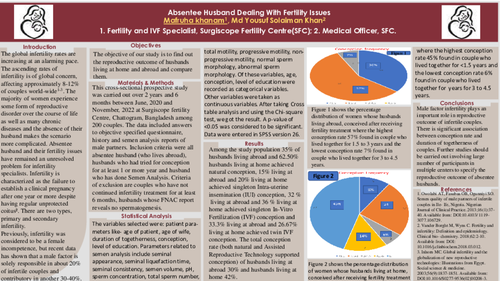
Among the study population 35% of husbands living abroad and 62.50% husbands living at home achieved natural conception, 15% living at abroad and 20% living at home achieved singleton Intra-uterine insemination (IUI) conception, 32 % living at abroad and 36 % living at home achieved singleton In-Vitro Fertilization (IVF) conception and 33.3% living at abroad and 26.67% living at home achieved twin IVF conception. The total conception rate (both natural and Assisted Reproductive Technology supported conception) of husbands living at abroad 30% and husbands living at home 42%.
Conclusion:
Male factor infertility plays an important role in reproductive outcome of infertile couples. There is significant association between conception rate and duration of togetherness of couples. Further studies should be carried out involving large number of participants in multiple centers to specify the reproductive outcome of absentee husbands.
References:
1. Owolabi AT, Fasubaa OB, Ogunniyi SO. Semen quality of male partners of infertile couples in Ile- Ife, Nigeria. Nigerian Journal of Clinical Practice. 2013;16(1):37-40. Available from: DOI:10.4103/ 1119-3077.106729.
2. Vander Borght M, Wyns C. Fertility and infertility: Definition and epidemiology. Clinical bio- chemistry. 2018;62:2-10. Available from: DOI: 10.1016/j.clinbiochem.2018.03.012.
3. Inhorn MC. Global infertility and the globalization of new reproductive technologies: Illustrations from Egypt. Social science & medicine. 2003;56(9):1837-1851. Available from: DOI:10.1016/S0277-9536(02)00208-3.