1,830 posters, 67 videos, 75 audios, 29 topics, 22 sessions, 4,727 authors, 1,697 institutions
ePostersLive by SciGen Technologies S.A. All rights reserved.
RCOG World Congress 2023
June 12 - 14, 2023 | London, UK

EP.1194
Predictive value of the sFlt-1:PlGF ratio is related to the placental dysfunction
Poster Presenter
Authors
Affiliations
Part of Topic
High Risk Pregnancy
To the question of the clinical predictive value of the sFlt-1:PlGF ratio is related to the placental dysfunction
Pylypenko Anastasiia V. - P.L. Shupyk National Healthcare University of Ukraine of Postgraduate Education, LELEKA Maternity Hospital, Kyiv, tel.:(044) 205-48-07. E-mail: PylypenkoNastya@ukr.net https://orcid.org/0000-0001-6830-0040
Medved Volodymyr I.- Department of internal Pathology of Pregnant Women of the Research Institute «Institute of Pediatrics, Obstetrics and Gynecology named after Academician O.M. Lukyanova National Academy of Medical Sciences of Ukraine», Kyiv; tel.:(044)483-61-67. Еmail:vladimirmedved@ukr.net https://orcid.org/0000-0002-4283-1211
Introduction. The etiology of pre-eclampsia is not sufficiently understood, but previous studies confirm the possibility that an imbalance of angiogenic factors plays an important role. Over the past decades, a better understanding of the pathophysiology of pre-eclampsia has improved the early detection of patients at risk. Specifically, it has been proven that an elevated ratio of soluble fms-like tyrosine kinase-1 (sFlt-1) and placental growth factor (PlGF) has high prognostic value for adverse outcomes associated with pre-eclampsia. It has been observed that sFlt-1 increases weeks before clinically manifested pre-eclampsia, confirming its role in the pathogenesis and raising hope for a pre-eclampsia predictor.
Оbjective.To assess the clinical and prognostic value as well as informativeness of the ratio of the antiangiogenic factor - soluble fms-like tyrosine kinase-1 and the angiogenic factor - placental growth factor in the dynamics of pregnancy, as a marker of various types of placental dysfunction.
Methods. Retrospective cohort study of 40 pregnant women who were stratified by gestational age (before 34 weeks and after 34 weeks) and sFlt-1:PlGF level (<38-low, >110-high). A statistical comparison of the sFlt-1:PlGF ratio with the development of hypertensive disorders and fetal growth retardation, as well as the duration of the period from the examination to the delivery, was carried out.
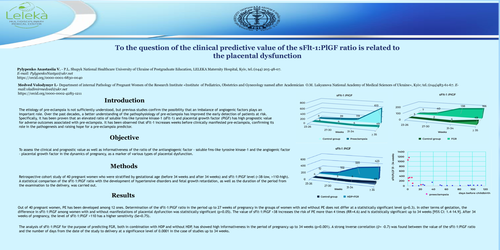
Results.Out of 40 pregnant women, PE has been developed among 12 ones. Determination of the sFlt-1:PlGF ratio in the period up to 27 weeks of pregnancy in the groups of women with and without PE does not differ at a statistically significant level (p=0.3). In other terms of gestation, the difference in sFlt-1:PlGF among women with and without manifestations of placental dysfunction was statistically significant (p<0.05). The value of sFlt-1:PlGF >38 increases the risk of PE more than 4 times (RR=4.6) and is statistically significant up to 34 weeks [95% CI: 1.4-14.9]. After 34 weeks of pregnancy, the level of sFlt-1:PlGF >110 has a higher sensitivity (Se=0.75).The analysis of sFlt-1:PlGF for the purpose of predicting FGR, both in combination with HDP and without HDP, has showed high informativeness in the period of pregnancy up to 34 weeks (p=0.001). A strong inverse correlation (Ƿ= -0.7) was found between the value of the sFlt-1:PlGF ratio and the number of days from the date of the study to delivery at a significance level of 0.0001 in the case of studies up to 34 weeks.