1,830 posters, 67 videos, 75 audios, 29 topics, 22 sessions, 4,727 authors, 1,697 institutions
ePostersLive by SciGen Technologies S.A. All rights reserved.
RCOG World Congress 2023
June 12 - 14, 2023 | London, UK

EP.1172
Co-infection of Monkeypox with Herpes simplex infection
Poster Presenter
Authors
Affiliations
Part of Topic
Hot Topics (Emerging research/issues) in Gynaecology
Monkey Pox, Atypical presentation: Co-infection
Dr Subbulakshmi Murugesan, Dr Megan Benson and Miss Afaf Diyaf
INTRODUCTION
Monkeypox virus (MPXV) is an endemic Orthopoxvirus (OPXV) in West and Central Africa. Until recently, most of the monkeypox cases have been reported in Africa and occasional exported infections have been linked to an animal vector or travel to endemic regions. Since May 2022, the ongoing human-to-human transmission outside of Africa has been responsible for the global outbreak.
The MPXV was thought to be transmitted mainly through direct contact with skin lesions and respiratory droplets. Classical descriptions of monkeypox depict patients initially presenting with a fever and systemic symptoms followed by a rash, which was most commonly monomorphic with a centrifugal distribution.
During the current outbreak, potential sexual transmission was suggested by the initial presentation of genital ulcers, mostly in men who have sex with men, where sexual contact occurred before the systemic illness. Also observed was the limitation of lesion localization only to the anogenital region.
Until now, >99% of patients infected are men and clinical cases of infected women are still very rare. With this case we highlight the fact that this zoonosis is also starting to spread among women. In the current outbreak, lesions frequently begin and affect the genital, anal and oral areas. Some cases developed proctitis (for ex. rectal pain, bloody stools, diarrhea). Facial lesions can potentially lead to ocular involvement, affecting the conjunctivae and cornea.
Monkeypox virus can cross the placental barrier. No case of vertical transmission has been reported in non-endemic countries. However, a case of fetal infection with pathological signs of monkeypox has been described from an endemic country, indicating the potential for vertical transmission.
Recent research published in The New England Journal of Medicine suggest that the current case definition of monkeypox needs to be broadened to include genital lesions and sores on the mouth or anus as symptoms to prevent misdiagnoses. These symptoms are similar to those of sexually transmitted infections (STIs), leading to potential misdiagnosis
The current outbreak of monkeypox differs in terms of epidemiology and clinical features. Firstly, a large proportion of cases occurring in non-endemic countries are reported among men who had recent sexual interactions with a new male partner or multiple partners. Secondly, many cases had only a few lesions, which could be localised to the genital area including mucosal surfaces, and appear without prodrome.
CASE PRESENTATION
We report the case of a 43 year old perimenopausal woman, with severe acute vulvar ulceration. She had a 4 day history of lower abdominal pain and itchy vulval lesions. There was a previous history of genital herpes simples and she has recently been diagnosed with Diabetes Mellitus. 4 weeks prior to the onset of symptoms, she had visited a country with a Monkeypox outbreak.
Intravenous antibiotics were started along with acyclovir, for suspected Pelvic Inflammatory Disease and possible Herpes flare up. The initial CRP was 98mg/DL and White cell count was 6.4x10⁹/L. Transvaginal scan was reported to be normal. Blood cultures were negative at 36 hours and the repeat C-Reactive Protein was 56mg/dL. Vulval biopsy showed a non-specific inflammatory process, with no evidence of lichen sclerosis, HPV associated changes, VIN or malignancy.
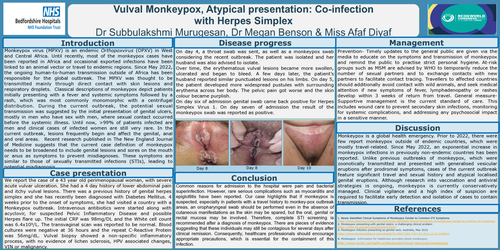
On day 4, a throat swab was sent, as well as a monkeypox swab considering the recent outbreak. The patient was isolated and her husband was also advised to isolate.
Over time, the erythematous vulval lesions became more swollen, ulcerated and began to bleed. Few days later, the patients husband reported similar punctuated lesions on his limbs. On day 5, the patient developed more widespread pustules with surrounding erythema across her body. The pelvic pain got worse and the skin colour became purplish.
On day six of admission genital swab came back positive for Herpes Simplex Virus 1. On day se of admission the result of the monkey pox swab was reported as positive.
DISCUSSION
Common reasons for admission to hospital were pain and bacterial superinfection. However, rare serious complications such as myocarditis and epiglottitis have been reported.
Our case highlights that if monkeypox is suspected, especially in patients with a travel history to monkey-pox outbreak areas, an oropharyngeal swab should be performed even in the absence of cutaneous manifestations as the skin may be spared, but the oral, genital or rectal mucosa may be involved. Therefore, complete STI screening is recommended after a diagnosis of monkeypox.
MANAGEMENT
Prevention- Timely updates to the general public are given via the media to educate on the symptoms and transmission of monkeypox and remind the public to practise strict personal hygiene. At-risk groups such as MSM are advised by WHO to temporarily reduce the number of sexual partners and to exchange contacts with new partners to facilitate contact tracing. Travellers to affected countries should additionally avoid contact with wild animals, and seek medical attention if new symptoms of fever, lymphadenopathy or rashes develop within 3 weeks of return from travel.
General measure- Supportive management is the current standard of care. This includes wound care to prevent secondary skin infections, monitoring for systemic complications, and addressing any psychosocial impact in a sensitive manner.
Pharmacologic treatment- In the UK, US and Australia, smallpox vaccination has been approved in certain circumstances to reduce the risk of monkeypox. As to the use of antivirals in confirmed monkeypox infection, WHO recommends that antiviral use be in the context of a randomised clinical trial.
There are evidences suggesting that these individuals may still be contagious for several days after clinical remission. Consequently, health care professionals should encourage appropriate precautions, which is essential for the containment of this infection.
CONCLUSION
Monkeypox is a global health emergency. Prior to 2022, there were few reports of monkeypox outside of endemic countries, which were mostly travel-related. Since May 2022, an exponential increase in monkeypox infections in previously non-endemic countries has been reported. Unlike previous outbreaks of monkeypox, which were zoonotically transmitted and presented with generalised vesicular eruptions after prodromal symptoms, cases of the current outbreak feature significant travel and sexual history, and atypical localised genital eruptions.
Although research into vaccination and antiviral strategies is ongoing, monkeypox is currently conservatively managed. Clinical vigilance and a high index of suspicion are required to facilitate early detection and isolation of cases to contain transmission.