1,830 posters, 67 videos, 75 audios, 29 topics, 22 sessions, 4,727 authors, 1,697 institutions
ePostersLive by SciGen Technologies S.A. All rights reserved.
RCOG World Congress 2023
June 12 - 14, 2023 | London, UK

EP.1158
Analysing 17000 deliveries, cesarean section for large babies reduced shoulder dystocia
Poster Presenter
Authors
Affiliations
Part of Topic
High Risk Pregnancy
Analysing 17000 deliveries, cesarean section for large babies
reduced shoulder dystocia
Mr.Hashem
Elhossamy
The Dudley group NHS trust, Dudley, United Kingdom
Contact: Hashem.Elhossamy@NHS.NET
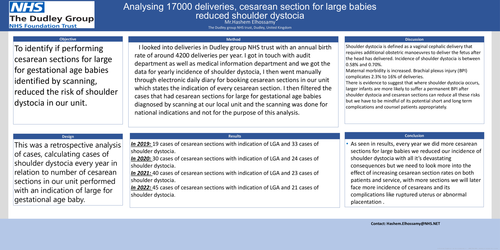
I looked into deliveries in Dudley group NHS trust with an annual birth
rate of around 4200 deliveries per year. I got in touch with audit
department as well as medical information department and we got the
data for yearly incidence of shoulder dystocia, I then went manually
through electronic daily diary for booking cesarean sections in our unit
which states the indication of every cesarean section. I then filtered the
cases that had cesarean sections for large for gestational age babies
diagnosed by scanning at our local unit and the scanning was done for
national indications and not for the purpose of this analysis.
Objective
Discussion
• As seen in results, every year we did more cesarean
sections for large babies we reduced our incidence of
shoulder dystocia with all it’s devastating
consequences but we need to look more into the
effect of increasing cesarean section rates on both
patients and service, with more sections we will later
face more incidence of cesareans and its
complications like ruptured uterus or abnormal
placentation .
Conclusion
To identify if performing
cesarean sections for large
for gestational age babies
identified by scanning,
reduced the risk of shoulder
dystocia in our unit.
Method
Design
This was a retrospective analysis
of cases, calculating cases of
shoulder dystocia every year in
relation to number of cesarean
sections in our unit performed
with an indication of large for
gestational age baby.
Shoulder dystocia is defined as a vaginal cephalic delivery that
requires additional obstetric manoeuvres to deliver the fetus after
the head has delivered. Incidence of shoulder dystocia is between
0.58% and 0.70%.
Maternal morbidity is increased. Brachial plexus injury (BPI)
complicates 2.3% to 16% of deliveries.
There is evidence to suggest that where shoulder dystocia occurs,
larger infants are more likely to suffer a permanent BPI after
shoulder dystocia and cesarean sections can reduce all these risks
but we have to be mindful of its potential short and long term
complications and counsel patients appropriately.
In 2019: 19 cases of cesarean sections with indication of LGA and 33 cases of
shoulder dystocia.
In 2020: 30 cases of cesarean sections with indication of LGA and 24 cases of
shoulder dystocia.
In 2021: 40 cases of cesarean sections with indication of LGA and 23 cases of
shoulder dystocia.
In 2022: 45 cases of cesarean sections with indication of LGA and 21 cases of
shoulder dystocia dystocia.
Results