1,830 posters, 67 videos, 75 audios, 29 topics, 22 sessions, 4,727 authors, 1,697 institutions
ePostersLive by SciGen Technologies S.A. All rights reserved.
RCOG World Congress 2023
June 12 - 14, 2023 | London, UK

EP.0113
Prevalence, Predictors and Outcomes of Small for Gestational Age in Twin Gestations
Poster Presenter
Part of Topic
High Risk Pregnancy
Twin pregnancies are at increased risk of developing neonatal complications such as low birth weight, preterm births, and perinatal mortality. Small for gestational age (SGA) infants, defined internationally as infants with a birth weight below the 10th centile for gestational age, are at greater risk of hypoglycaemia, necrotizing enterocolitis, sepsis, polycythaemia, intraventricular haemorrhage and prolonged hospitalization. This study aims to ascertain the burden and outcome of twin pregnancies complicated by SGA.
Design: This was a two-year retrospective audit at the Korle Bu Teaching Hospital (KBTH), the largest referral centre in Ghana, from January 2020 to December 2021.
Method: Data were collected on all twin deliveries greater than 28 weeks gestation and included: maternal age, parity, gestational age at delivery, birthweight, fetal Apgar scores, and sex. The INTERGROWTH 21 Newborn Size Calculator was used to calculate the birthweight centiles, and twins with birthweights below the 10th centile were analyzed.
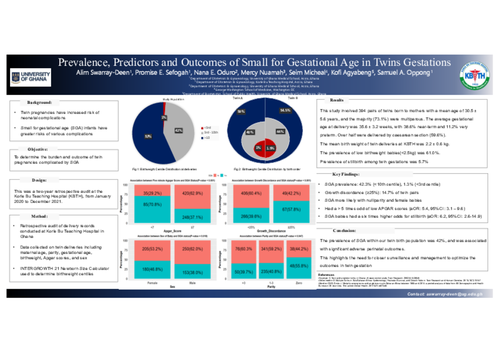
Results: This study involved 394 pairs of twins born to mothers with a mean age of 30.5 ± 5.6 years, and the majority (73.1%) were multiparous. The average gestational age at delivery was 35.6 ± 3.2 weeks, with 38.6% near-term and 11.2% very preterm. Over half were delivered by caesarean section (59.6%).
The mean birth weight of twin deliveries at KBTH was 2.2 ± 0.6 kg. The prevalence of low birthweight babies(<2.5kg) was 61.0%. Using the Intergrowth centile charts for Newborns based on gestational age, the prevalence of SGA babies (<10th centile) was 42.3%, and babies <3rd centile accounted for 1.3% of the cases. Growth discordance of ≥ 25% was recorded among 14.7% of twin pairs. Babies with ≥ 25% growth discordance contributed to an 18.2% higher proportion of SGA babies than babies with < 25% growth discordance. The prevalence of stillbirth among twin gestations was 5.7%.
SGA babies had higher odds of being born to a nullipara mother (aOR:1.90, 95%CI: 1.01 – 3.59), being females (aOR:1.45, 95%CI: 1.06 – 1.99), having growth discordance of ≥ 25% (aOR: 2.07, 95%CI: 1.42 – 3.03) and having low Apgar score (<7) at 5minutes (aOR:5.42, 95%CI: 3.17-9.26). In addition, SGA babies had six times higher odds for stillbirth (aOR: 6.2, 95%CI: 2.6-14.9)
Conclusion: The prevalence of SGA within our twin birth population was 42.3%, and SGA was associated with significant adverse perinatal outcomes. This audit highlights the need for closer surveillance and management to optimize the outcomes in twin gestation.