1,830 posters, 67 videos, 75 audios, 29 topics, 22 sessions, 4,727 authors, 1,697 institutions
ePostersLive by SciGen Technologies S.A. All rights reserved.
RCOG World Congress 2023
June 12 - 14, 2023 | London, UK

EP.1140
Rare case of post caesarean section uterine dehiscence, intra-abdominal sepsis and endomyometritis.
Poster Presenter
Authors
Affiliations
Part of Topic
Labour Ward Management
Rare case of post caesarean section uterine dehiscence associated with intra-abdominal sepsis and endomyometritis.
Misbah Malik1. Androniks Mumdzjans2, Jaishree Hingorani3
CASE REPORT:
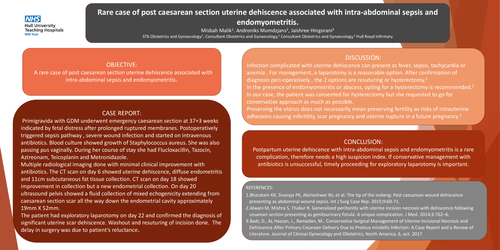
Primigravida with GDM underwent emergency caesarean section at 37+3 weeks indicated by fetal distress after prolonged ruptured membranes. Postoperatively triggered sepsis pathway , severe wound infection and started on intravenous antibiotics. Blood culture showed growth of Staphylococcus aureus. She was also passing pus vaginally. During her course of stay she had Flucloxacillin, Tazocin, Aztreonam, Teicoplanin and Metronidazole.
Multiple radiological imaging done with minimal clinical improvement with antibiotics. The CT scan on day 6 showed uterine dehiscence, diffuse endometritis and 11cm subcutaneous fat tissue collection. CT scan on day 18 showed improvement in collection but a new endometrial collection. On day 20 ultrasound pelvis showed a fluid collection of mixed echogenicity extending from caesarean section scar all the way down the endometrial cavity approximately 19mm X 52mm.
The patient had exploratory laparotomy on day 22 and confirmed the diagnosis of significant uterine scar dehiscence. Washout and resuturing of incision done. The delay in surgery was due to patient’s reluctance.
DISCUSSION:
Infection complicated with uterine dehiscence can present as fever, sepsis, tachycardia or anemia . For management, a laparotomy is a reasonable option. After confirmation of diagnosis peri-operatively , the 2 options are resuturing or hysterectomy.1
In the presence of endomyometritis or abscess, opting for a hysterectomy is recommended.2 In our case, the patient was consented for hysterectomy but she requested to go for conservative approach as much as possible.
Preserving the uterus does not necessarily mean preserving fertility as risks of intrauterine adhesions causing infertility, scar pregnancy and uterine rupture in a future pregnancy.3
CONCLUSION:
Postpartum uterine dehiscence with intra-abdominal sepsis and endomyometritis is a rare complication, therefore needs a high suspicion index. If conservative management with antibiotics is unsuccessful, timely proceeding for exploratory laparotomy is important.