1,830 posters, 67 videos, 75 audios, 29 topics, 22 sessions, 4,727 authors, 1,697 institutions
ePostersLive by SciGen Technologies S.A. All rights reserved.
RCOG World Congress 2023
June 12 - 14, 2023 | London, UK

EP.1135
Chronic Ovarian torsion: an unusual cause of persistent foetal transverse lie
Poster Presenter
Authors
Affiliations
Part of Topic
High Risk Pregnancy
Chronic Ovarian Torsion: An Unusual Cause of Persistent Transverse Fetal Lie
This report discusses a case of chronic left ovarian torsion causing uterine malrotation resulting in persistent fetal transverse lie.
This primiparous patient was in her early forties and conceived with a donor egg and her husband’s sperm following a long history of primary infertility. Her BMI was 22 and she was otherwise fit and well with no past medical or surgical history.
The patient had undergone investigations for infertility including transvaginal ultrasound which did not identify uterine structural anomaly or ovarian pathology (left ovary not clearly identified). Attempted egg harvest was unsuccessful, therefore the couple conceived with a donor egg.
Antenatally, this patient was assigned to the SGA pathway due to her age and underwent serial growth scans throughout her Pregnancy. At 36/40, EFW and AC > 95% and AFI 30cm with transverse fetal lie. She was admitted at 37/40 to await Elective LSCS at 39/40 due to risk of cord prolapse.
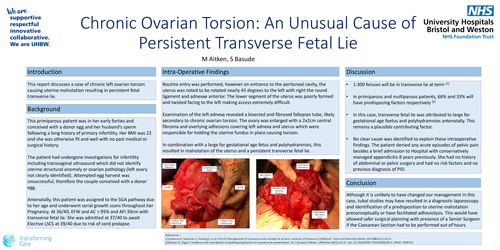
Routine entry was performed, however on entrance to the peritoneal cavity, the uterus was noted to be rotated nearly 45 degrees to the left with right the round ligament and adnexae anterior. The lower segment of the uterus was poorly formed and twisted facing to the left making access extremely difficult.
Examination of the left adnexa revealed a bisected and fibrosed fallopian tube, likely secondary to chronic ovarian torsion. The ovary was enlarged with a 2x2cm central fibroma and overlying adhesions covering left adnexa and uterus which were responsible for holding the uterine fundus in place causing torsion.
In combination with a large for gestational age fetus and polyhydramnios, this resulted in malrotation of the uterus and a persistent transverse fetal lie.