1,830 posters, 67 videos, 75 audios, 29 topics, 22 sessions, 4,727 authors, 1,697 institutions
ePostersLive by SciGen Technologies S.A. All rights reserved.
RCOG World Congress 2023
June 12 - 14, 2023 | London, UK

EP.1120
Cervical buttonhole tears: a rare intrapartum complication
Poster Presenter
Authors
Affiliations
Part of Topic
Hot Topics (Emerging research/issues) in Obstetrics
Cervical buttonhole tears: a rare intrapartum complication
Introduction:
Cervical tears are a rare intrapartum complication with an incidence of
0.2%. These are associated with postpartum haemorrhage.
Reported intrapartum cervical injuries include annular tears, bucket
handle tears, and avulsion or complete cervical detachment. Here we
report a previously un-described buttonhole tear of the cervix.
Case:
Ø 36 year old IVF pregnancy, routine postdate inductions at 41+6/40
Ø Uncomplicated induction and first stage, required a lift out Neville-
Barnes Forceps Delivery due to delay in second stage.
Ø During episiotomy suturing she had a major postpartum
haemorrhage initially thought to be due to uterine atony, failure
of uterotonics led to identification of a cervical buttonhole tear
Ø Examination findings: patulous cervix with a 4cm longitudinal
buttonhole tear of the anterior cervix at 12 o’clock position
with an intact external cervical os.
Ø Tear repaired with vicryl 2-0 using 4 interrupted sutures spaced
1cm apart
Ø Canal patency was ensured by inserting a sigmoidoscope
Ø Counselled on implication for future pregnancies with
recommendation for referral to pre-term birth prevention clinic
Discussion:
MECHANISM
The mechanism behind intrapartum cervical tears remains to be elucidated
with several postulations with a lack of evidence. Some of these include:
• Bearing down on a partially dilated cervix
• Iatrogenic response to multiple examinations
• Oedema and necrosis to to cervix as it is compressed between vertex and
pubic symphysis however this doesn’t explain posterior lip tears.
• Underlying fibrotic changes to cervix
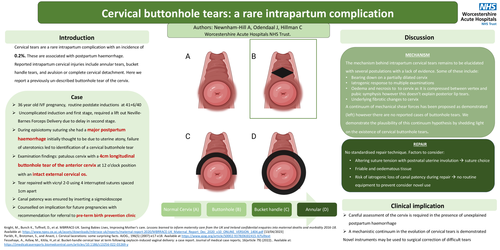
A continuum of mechanical shear forces has been proposed as demonstrated
(left) however there are no reported cases of buttonhole tears. We
demonstrate the plausibility of this continuum hypothesis by shedding light
on the existence of cervical buttonhole tears.
REPAIR
No standardised repair technique. Factors to consider:
• Altering suture tension with postnatal uterine involution àsuture choice
• Friable and oedematous tissue
• Risk of iatrogenic loss of canal patency during repair àno routine
equipment to prevent consider novel use
Clinical Implication:
Ø Careful assessment of the cervix is required in the presence of unexplained
postpartum haemorrhage
Ø A mechanistic continuum in the evolution of cervical tears is demonstrated
Novel instruments may be used to surgical correction of difficult tears