1,830 posters, 67 videos, 75 audios, 29 topics, 22 sessions, 4,727 authors, 1,697 institutions
ePostersLive by SciGen Technologies S.A. All rights reserved.
RCOG World Congress 2023
June 12 - 14, 2023 | London, UK

EP.1119
Syndrome of inappropriate antidiuretic hormone secretion in pregnancy
Poster Presenter
Authors
Affiliations
Part of Topic
Maternal Medicine
Syndrome of inappropriate antidiuretic hormone secretion in pregnancy
Sandya PH, Rathnayake T, Uduwerella S
Teaching Hospital Kurunegala, Sri Lanka.
Objective
Syndrome of inappropriate antidiuretic hormone secretion (SIADH) is characterized by impaired water excretion leading to hyponatremia. It can occur de-novo during pregnancy with physiological changes.
Case report
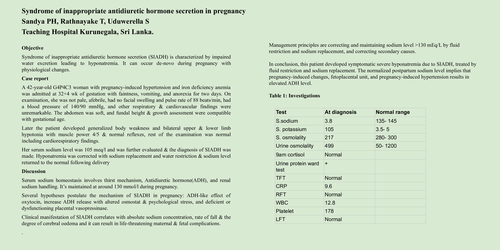
A 42-year-old G4P4C3 woman with pregnancy-induced hypertension and iron deficiency anemia was admitted at 32+4 wk of gestation with faintness, vomiting, and anorexia for two days. On examination, she was not pale, afebrile, had no facial swelling and pulse rate of 88 beats/min, had a blood pressure of 140/90 mmHg, and other respiratory & cardiovascular findings were unremarkable. The abdomen was soft, and fundal height & growth assessment were compatible with gestational age.
Later the patient developed generalized body weakness and bilateral upper & lower limb hypotonia with muscle power 4/5 & normal reflexes, rest of the examination was normal including cardiorespiratory findings.
Her serum sodium level was 105 meq/l and was further evaluated & the diagnosis of SIADH was made. Hyponatremia was corrected with sodium replacement and water restriction & sodium level returned to the normal following delivery
Discussion
Serum sodium homeostasis involves thirst mechanism, Antidiuretic hormone(ADH), and renal sodium handling. It’s maintained at around 130 mmol/l during pregnancy.
Several hypotheses postulate the mechanism of SIADH in pregnancy: ADH-like effect of oxytocin, increase ADH release with altered osmostat & psychological stress, and deficient or dysfunctioning placental vasopressinase.
Clinical manifestation of SIADH correlates with absolute sodium concentration, rate of fall & the degree of cerebral oedema and it can result in life-threatening maternal & fetal complications.
Management principles are correcting and maintaining sodium levels>130 mEq/L by fluid restriction and sodium replacement, and correcting secondary causes.
In conclusion, this patient developed symptomatic severe hyponatremia due to SIADH, treated by fluid restriction and sodium replacement. The normalized postpartum sodium level implies that pregnancy-induced changes, fetoplacental unit, and pregnancy-induced hypertension results in elevated ADH level.