1,830 posters, 67 videos, 75 audios, 29 topics, 22 sessions, 4,727 authors, 1,697 institutions
ePostersLive by SciGen Technologies S.A. All rights reserved.
RCOG World Congress 2023
June 12 - 14, 2023 | London, UK

EP.1118
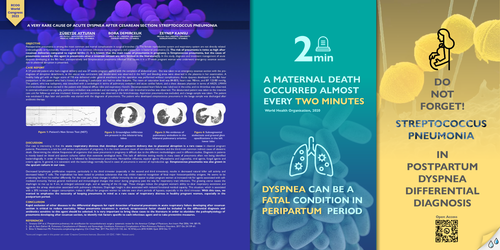
A VERY RARE CAUSE OF ACUT DİSPNEA AFTER CESAREAN SECTİON ; STREPTOCOCCUS PNEUMONİAE
Part of Topic
Hot Topics (Emerging research/issues) in Obstetrics
OBJECTİVE
Postoperative pneumonias are among the most common and mortal complications in surgical branches.(1)The female reproductive system and respiratory system are not directly related embryologically or functionally.However, one of the common infections during pregnancy and postpartum is bacterial pneumonia.(2)The risk of pneumonia is twice as high after cesarean deliveries compared to vaginal births.(3)It is known that the main cause of pneumonia in pregnancy is Streptococcus pneumoniae, but the cases of pneumonia caused by this agent in pneumonia after cesarean section are very limited in the literatüre(3).In this study, diagnosis and treatment management of acute dyspnea developing at the 8th hour postoperatively and Streptococcus pneumoniae infection that causes it in a 37-week pregnant woman who underwent emergency cesarean section due to placental abruption is presented.
CASE REPORT
A 27-year-old patient who had a vaginal delivery and was 37 weeks pregnant applied with the complaint of abdominal pain. She was taken to emergency cesarean section with the pre-diagnosis of abruptio detachment, as the uterus was contracted, late deceleration was observed in the NST, and bleeding areas were observed in the placenta in her examination.
A healthy baby girl with an Apgar score of 7/8 was delivered under general anesthesia and the operation was performed without complications.Acute dyspnea developed at the 8th hour postpartum in the patient who had a history of smoking 5 packs/year and had no other features. The room air saturation level was 84-85%, heart rate: 98/min, BP: 125/80 mmHg.
The patient, who was tachypneic, was consulted to the cardiologist in terms of pulmonary embolism and acute cardiac failure, and a chest diseases physician in terms of ARDS. LMWH and bronchodilator were started in the patient with bilateral diffuse rales and expiratory rhonchi.Decompensated heart failure was ruled out in the echo, no thrombus was observed. In contrast-enhanced tomography, pulmonary embolism was excluded and narrowing of the left main bronchial branches was observed.The desaturated patient was taken to the intensive care unit for follow-up and was intubated.Intense purulent secretion was observed in the bronchospi. Aspiration pneumonia was excluded and a lavage sample was taken.The patient was extubated 2 days later and penicillin was started with the diagnosis of pneumonia. The patient who developed streptecoccus pneumonia in the lavage sample was discharged after antibiotic therapy.
DİSCUSSİON:Our case is interesting in that the acute respiratory distress that develops after preterm delivery due to placental abruption is due to a rare cause in classical pregnant patients. Pneumonia is a rare but still serious complication of pregnancy. It is the most common cause of non-obstetric infections and the third most common indirect cause of obstetric death.
Determining the relative frequencies of organisms that cause pneumonia in pregnancy is difficult due to different methodologies used in different studies. Diagnosis in patients is mostly based on blood and sputum cultures rather than extensive serological tests. This lack of definitive testing results in many cases of pneumonia often not being identified bacteriologically. In order of frequency; It is followed by Streptococcus pneumoniae, Hemophilus influenza, atypical agents (Mycoplasma and Legionella), viral agents, fungal agents and enteric agents. In general, it is consistent with the bacteriology normally found in cases of pneumonia in women of reproductive age. Streptococcus pneumoniae was also grown in the sputum culture in our case.
Decreased lymphocyte proliferative response, particularly in the third trimester (especially in the second and third trimesters), results in decreased natural killer cell activity and decreased helper T cells. The trophoblast has been noted to produce substances that may inhibit maternal recognition of fetal major histocompatibility antigens. He seems to be protecting her from his mother differently. For the most part, these changes in cellular immunity do not appear to place pregnant women at increased risk for agents associated with cell-mediated immunity.
Various general mechanical and immunological changes that occur during pregnancy pave the way for respiratory tract infections. The growing uterus causes the diaphragm to rise up to 4 cm, an enlarged subcostal angle, and an opening of the rib cage. These changes reduce the pregnant woman's ability to clear respiratory secretions and aggravate the airway obstruction associated with pulmonary infections. Diaphragm height is also associated with reduced functional residual capacity. . This situation, which is associated with a 20% increase in oxygen consumption, makes it difficult for pregnant women to tolerate even short periods of hypoxia, especially in the third trimester.
With this case, we wanted to emphasize the necessity of keeping pneumonia in mind as a rare cause of respiratory distress in healthy pregnant women, especially in the postpartum period.
CONCLUSİON
Rapid exclusion of other diseases in the differential diagnosis for rapid detection of bacterial pneumonia in acute respiratory failure developing after cesarean section is critical to reduce mortality.When pneumonia treatment is started, streptococcal factor should be included in the differential diagnosis and antibiotics sensitive to this agent should be selected.It is very important to bring these cases to the literature in order to elucidate the pathophysiology of pneumonia developing after cesarean section, to identify risk factors specific to each infectious agent and to take preventive measures.
(1) Smetana GW, Lawrance VA, Cornell JE. Preoperative pulmonary risk stratification for noncardiothoracic surgery: systematic review for the American College of Physicians. Ann Intern Med 2006; 144: 581-95.
(2)https://www.ncbi.nlm.nih.gov/pmc/articles/PMC7121584/
(3)https://www.ncbi.nlm.nih.gov/pmc/articles/PMC7131287/