1,830 posters, 67 videos, 75 audios, 29 topics, 22 sessions, 4,727 authors, 1,697 institutions
ePostersLive by SciGen Technologies S.A. All rights reserved.
RCOG World Congress 2023
June 12 - 14, 2023 | London, UK

EP.1116
Inferior Vermian Hypoplasia - A case report
Poster Presenter
Authors
Affiliations
Part of Topic
High Risk Pregnancy
Inferior Vermian Hypoplasia – Pearls and pitfalls
Author: Dr.Siddiqua Banu Sayeeda, Specialist, Obstetrician and Gynaecologist.
MBBS,DGO,DNB,MRCOG, Mediclinic AbuDhabi.
Background :
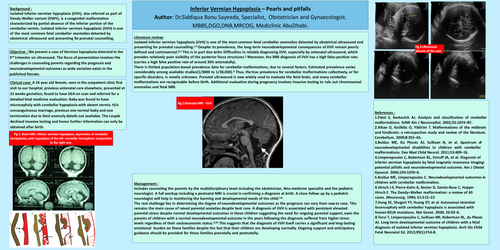
Isolated inferior vermian hypoplasia (iiVH), also referred as part of Dandy-Walker variant (DWV), is a congenital malformation characterized by partial absence of the inferior portion of the cerebellar vermis. Isolated inferior vermian hypoplasia (iiVH) is one of the most common fetal cerebellar anomalies detected by obstetrical ultrasound and presenting for prenatal counselling.
Objective:
We present a case of Vermian hypoplasia detected in the 3rd trimester on ultrasound. The focus of presentation involves the challenges in counseling parents regarding the prognosis and neurodevelopmental outcomes as wide variation exists in the published literate.
Clinical case:
A 24 year old female, seen in the outpatient clinic first visit to our hospital, previous antenatal care elsewhere, presented at 31 weeks gestation, found to have SGA on scan and referred for a detailed fetal medicine evaluation. Baby was found to have microcephaly with cerebellar hypoplasia with absent vermis. H/o consanguineous marriage, previous one normal baby and one termination due to fetal anomaly details not available. The couple declined invasive testing and hence further information can only be obtained after birth.
Literature review: Isolated inferior vermian hypoplasia (iiVH) is one of the most common fetal cerebellar anomalies detected by obstetrical ultrasound and presenting for prenatal counselling.[1–3] Despite its prevalence, the long-term neurodevelopmental consequences of iiVH remain poorly defined and controversial.[4,5] There is limited population-based prevalence data for cerebellar malformations, due to several factors. Estimated prevalence varies considerably among available studies (1/3000 to 1/30,000) [6]. Thus, the true prevalence for cerebellar malformations collectively, or for specific disorders, is mostly unknown. Prenatal ultrasound is now widely used to evaluate the fetal brain, and many cerebellar malformations are recognizable before birth. Additional evaluation during pregnancy involves Invasive testing to rule out chromosomal anomalies and fetal MRI(carries a high false positive rate of around 30% antenatally).
The management includes counseling the parents by the multidisciplinary team including the obstetrician , feto-medicine specialist and the pediatric neurologist. A full workup including a postnatal MRI is crucial in confirming a diagnosis at birth . A close follow up by a pediatric neurologist will help in monitoring the learning and developmental needs of the child.
The real challenge lies in determining the degree of neurodevelopmental outcomes as the prognosis can vary from case to case. This remains the main cause of raised parental anxieties despite best care.
1. Patel S, Barkovich AJ. Analysis and classification of cerebellar malformations. AJNR Am J Neuroradiol. 2002;23:1074–87.
2. Alkan O, Kizilkilic O, Yildirim T. Malformations of the midbrain and hindbrain: a retrospective study and review of the literature. Cerebellum. 2009;8:355–65.
3. Bolduc ME, Du Plessis AJ, Sullivan N, et al. Spectrum of neurodevelopmental disabilities in children with cerebellar malformations. Dev Med Child Neurol. 2011;53:409–16.
4. Limperopoulos C, Robertson RL, Estroff JA, et al. Diagnosis of inferior vermian hypoplasia by fetal magnetic resonance imaging: potential pitfalls and neurodevelopmental outcome. Am J Obstet Gynecol. 2006;194:1070–6.
5. Bolduc ME, Limperopoulos C. Neurodevelopmental outcomes in children with cerebellar malformations: a systematic review. Dev Med Child Neurol. 2009;51:256–67.
6. Hirsch J-F, Pierre-Kahn A, Renier D, Sainte-Rose C, Hoppe-Hirsch E. The Dandy–Walker malformation: a review of 40 cases. J Neurosurg. 1984; 61:515–22
7. Hong SE, Shugart YY, Huang DT, et al. Autosomal recessive lissencephaly with cerebellar hypoplasia is associated with human RELN mutations. Nat Genet. 2000; 26:93–6.
8. Tarui T, Limperopoulos C, Sullivan NR, Robertson RL, du Plessis AJ. Long-term developmental outcome of children with a fetal diagnosis of isolated inferior vermian hypoplasia. Arch Dis Child Fetal Neonatal Ed. 2013;99(1):F54-8.