1,830 posters, 67 videos, 75 audios, 29 topics, 22 sessions, 4,727 authors, 1,697 institutions
ePostersLive by SciGen Technologies S.A. All rights reserved.
RCOG World Congress 2023
June 12 - 14, 2023 | London, UK

EP.0110
THE COMPLIANCE TO GLUCOSE MEASUREMENTS IN NEWLY DIAGNOSED GESTATIONAL DIABETES MELLITUS PATIENTS
Poster Presenter
Authors
Yen Pham Thi Y, Phuoc Huynh Ngoc, Hieu Huynh Trung, Trang Pham Ngoc Doan, Ha Ngo Thanh, Dung Dang Ngoc Yen, Hang Phan Thi
Affiliations
Deputy of Labour and Delivery Department, Hung Vuong Hospital, (4) Bachelor of Public Health, General Planning Department, (2) Faculty of Information Technology Department, Industrial University of Ho Chi Minh City, (3) PhD candidate & Graduate Research Assistant, Departments of Epidemiology and Biostatistics & Biomedical and Health Information Sciences, University of Illinois at Chicago, (5) The OB/GYN physician, High risk pregnancy Department, Hung Vuong Hospital, (6) Head of Outpatient Department, Hung Vuong Hospital, (7) Vice-Director, Hung Vuong hospital
Part of Topic
High Risk Pregnancy
THE COMPLIANCE TO GLUCOSE MEASUREMENTS IN NEWLY DIAGNOSED GESTATIONAL DIABETES MELLITUS PATIENTS
Pham Thi Y Yen, MD, MSc1, Huynh Ngoc Phuoc2, Huynh Trung Hieu, PhD3, Pham Ngoc Doan Trang, PhD(c), MS, MD4, , Ngo Thanh Ha, MD5, Dang Ngoc Yen Dung, MD6; Phan Thi Hang, MD, PhD7.
(1) Deputy of Labour and Delivery Department, Hung Vuong Hospital, Ho Chi Minh city, Vietnam
(2) Bachelor of Public Health, General Planning Department, Hung Vuong Hospital, Ho Chi Minh city, Vietnam
(3) Faculty of Information Technology Department, Industrial University of Ho Chi Minh City, Vietnam
(4) PhD candidate & Graduate Research Assistant, Departments of Epidemiology and Biostatistics & Biomedical and Health Information Sciences, University of Illinois at Chicago
(5) The OB/GYN physician, High risk pregnancy Department, Hung Vuong Hospital, Ho Chi Minh city, Vietnam.
(6) Head of Outpatient Department, Hung Vuong Hospital, Ho Chi Minh city, Vietnam
(7) Vice-Director, Hung Vuong hospital, Ho Chi Minh city, Vietnam
Objective: We conducted a RCT to determine whether the use of a smartphone app (IOH- internet of health) with short message service to remind patients of measuring scheduled blood glucose to manage women with gestational diabetes mellitus (GDM) was as effective in assisting compliance to glucose measurements as standard care through clinic attendance.
Design: A prospective, nonblinded randomized controlled trial.
Method: Women with less than 34 weeks of gestation and newly diagnosed GDM determined by 75g oral glucose tolerance test with no value ≥ 200mg/dl, were individually randomized to an intervention group which uses smartphone app blood glucose management solution or a routine clinic care group. Women were guided to measure fasting and two-hour postprandial self-monitoring of blood glucose at the 3rd and 7th day after the day of GDM diagnosed. Patients were re-examined at the 14th to measure fasting and two-hour postprandial at hospital. Each patient in the intervetion group received four scheduled messages during the 14 days. The primary outcome was patient compliance defined as the actual blood glucose measurements/instructed measurements x 100. The secondary outcome was a glycemic control defined as sum of target blood glucose measurements/ measurements. The last outcome was patient satisfaction of IOH assessed by System Usability Scale.
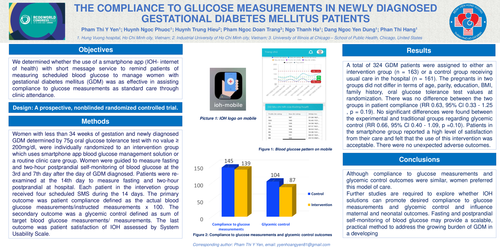
Results: A total of 324 GDM patients were assigned to either an intervention group (n = 163) or a control group receiving usual care in the hospital (n = 161). The pregnants in two groups did not differ in terms of age, parity, education, BMI, family history, oral glucose tolerance test values at randomization. There was no difference between the two groups in patient compliance (RR 0.63, 95% Cl 0.33 - 1.25 , p = 0.19). No significant differences were found between the experimental and traditional groups regarding glycemic control (RR 0.66, 95% Cl 0.40 - 1.09, p =0.10). Patients in the smartphone group reported a high level of satisfaction from their care and felt that the use of this intervention was acceptable. There were no unexpected adverse outcomes.
Conclusions: Although compliance to glucose measurements and glycemic control outcomes were similar, women preferred this model of care. Further studies are required to explore whether IOH solutions can promote desired compliance to glucose measurements and glycemic control and influence maternal and neonatal outcomes. Fasting and postprandial self-monitoring of blood glucose may provide a scalable, practical method to address the growing burden of GDM in a developing country.