1,830 posters, 67 videos, 75 audios, 29 topics, 22 sessions, 4,727 authors, 1,697 institutions
ePostersLive by SciGen Technologies S.A. All rights reserved.
RCOG World Congress 2023
June 12 - 14, 2023 | London, UK

EP.1110
Tubo-ovarian abscess after a low-dependency pregnancy & uncomplicated vaginal birth.
Poster Presenter
Authors
Affiliations
Part of Topic
Benign Gynaecology
Objective: Pelvic abscess after uncomplicated vaginal delivery is a rarity. We are presenting a case of right-sided tubo-ovarian abscess after an uncomplicated spontaneous term vaginal birth and a low-dependency pregnancy. We could find no other report describing pelvic abscess in a similarly uncomplicated postpartum patient. Our objective is to increase the awareness of this entity to be included in the differential diagnosis in otherwise healthy postpartum patients presenting with persistent abdominal pain and fever.
Case report
A 25 years old primigravida who had a low dependency pregnancy and spontaneous labour & vaginal birth with an intact perineum at term, presented 7 weeks postpartum with severe constant lower abdominal pain associated with fever of 3 days duration.
On examination, she was pyrexial and tachycardic, and her blood pressure, respiratory rate & saturation were normal, with tenderness & rebound tenderness in the right iliac fossa.
Blood tests demonstrated raised white blood cell count and C reactive protein.
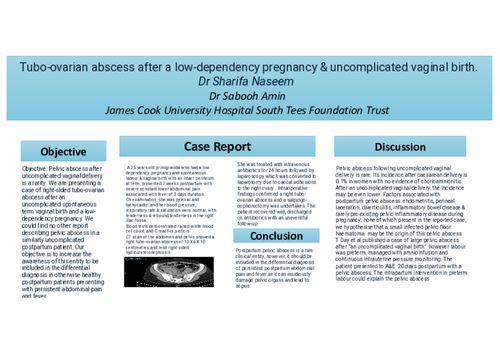
CT scan of the abdomen and pelvis showed a right tubo-ovarian abscess of 10 X6 X 10 centimetres and mild right hydroureteronephrosis. She was treated with intravenous antibiotics for 24 hours followed by laparoscopy which was converted to laparotomy due to caecal adhesions to the right ovary. Intraoperative findings confirmed a right tubo-ovarian abscess and a salpingo-oophorectomy was undertaken. The patient recovered well, discharged on antibiotics with an uneventful follow-up.
Discussion: Pelvic abscess following uncomplicated vaginal delivery is rare. Its incidence after caesarean delivery is 0.1% in women with no evidence of chorioamnionitis. After an uncomplicated vaginal delivery, the incidence may be even lower. Factors associated with postpartum pelvic abscess: endometritis, perineal laceration, diverticulitis, inflammatory bowel disease & rarely pre-existing pelvic inflammatory disease during pregnancy; none of which present in the reported case, we hypothesise that a small infected pelvic floor haematoma may be the origin of this pelvic abscess
T Day et al published a case of large pelvic abscess after ‘’an uncomplicated vaginal birth’’ however labour was preterm, managed with amnioinfusion and continuous intrauterine pressure monitoring. The patient presented to A&E 20 days postpartum with a pelvic abscess. The intrapartum intervention in preterm labour could explain the pelvic abscess.
Conclusion
Postpartum pelvic abscess is a rare clinical entity, however, it should be included in the differential diagnosis of persistent postpartum abdominal pain and fever as it can insidiously damage pelvic organs and lead to sepsis.