1,830 posters, 67 videos, 75 audios, 29 topics, 22 sessions, 4,727 authors, 1,697 institutions
ePostersLive by SciGen Technologies S.A. All rights reserved.
RCOG World Congress 2023
June 12 - 14, 2023 | London, UK

EP.1108
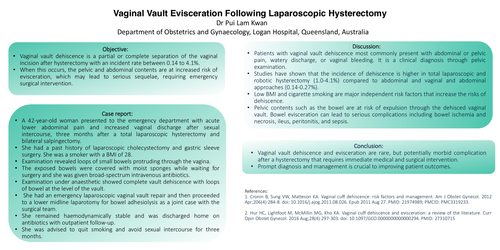
Vaginal vault evisceration following laparoscopic hysterectomy
Poster Presenter
Authors
Affiliations
Part of Topic
Hot Topics (Emerging research/issues) in Gynaecology
Objective:
•Vaginal vault dehiscence is a partial or complete separation of the vaginal incision after hysterectomy with an incident rate between 0.14 to 4.1%.
•When this occurs, the pelvic and abdominal contents are at increased risk of evisceration, which may lead to serious sequelae, requiring emergency surgical intervention.
Case report:
•A 42-year-old woman presented to the emergency department with acute lower abdominal pain and increased vaginal discharge after sexual intercourse, three months after a total laparoscopic hysterectomy and bilateral salpingectomy.
•She had a past history of laparoscopic cholecystectomy and gastric sleeve surgery. She was a smoker with a BMI of 28.
•Examination revealed loops of small bowels protruding through the vagina.
•The exposed bowels were covered with moist sponges while waiting for surgery and she was given broad-spectrum intravenous antibiotics.
•Examination under anaesthetic showed complete vault dehiscence with loops of bowel at the level of the vault.
• She had an emergency laparoscopic vaginal vault repair and then proceeded to a lower midline laparotomy for bowel adhesiolysis as a joint case with the surgical team.
•She remained haemodynamically stable and was discharged home on antibiotics with outpatient follow-up.
•She was advised to quit smoking and avoid sexual intercourse for three months.
Discussion:
•Patients with vaginal vault dehiscence most commonly present with abdominal or pelvic pain, watery discharge, or vaginal bleeding. It is a clinical diagnosis through pelvic examination.
•Studies have shown that the incidence of dehiscence is higher in total laparoscopic and robotic hysterectomy (1.0-4.1%) compared to abdominal and vaginal and abdominal approaches (0.14-0.27%).
•Low BMI and cigarette smoking are major independent risk factors that increase the risks of dehiscence.
•Pelvic contents such as the bowel are at risk of expulsion through the dehisced vaginal vault. Bowel evisceration can lead to serious complications including bowel ischemia and necrosis, ileus, peritonitis, and sepsis.
Conclusion:
•Vaginal vault dehiscence and evisceration are rare, but potentially morbid complication after a hysterectomy that requires immediate medical and surgical intervention.
•Prompt diagnosis and management is crucial to improving patient outcomes.