1,830 posters, 67 videos, 75 audios, 29 topics, 22 sessions, 4,727 authors, 1,697 institutions
ePostersLive by SciGen Technologies S.A. All rights reserved.
RCOG World Congress 2023
June 12 - 14, 2023 | London, UK

EP.1103
An Unusual Cause of Postpartum Maternal Collapse
Poster Presenter
Authors
Affiliations
Part of Topic
High Risk Pregnancy
An Unusual Cause of Postpartum Maternal Collapse
Objective
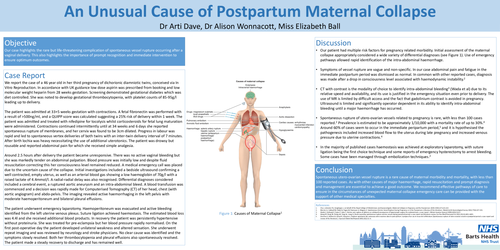
Our case highlights the rare but life-threatening complication of spontaneous vessel rupture occurring after a vaginal delivery. This also highlights the importance of prompt recognition and immediate intervention to ensure optimum outcomes.
Case Report
We report the case of a 46 year old in her third pregnancy of dichorionic diamniotic twins, conceived via In Vitro Reproduction. In accordance with UK guidance low dose aspirin was prescribed from booking and low molecular weight heparin from 28 weeks gestation. Screening demonstrated gestational diabetes which was diet controlled. She was noted to develop gestational thrombocytopenia, with platelet counts of 85-95g/l leading up to delivery.
The patient was admitted at 33+5 weeks gestation with contractions. A fetal fibronectin was performed with a result of >500ng/ml, and a QUIPP score was calculated suggesting a 25% risk of delivery within 1 week. The patient was admitted and treated with nifedipine for tocolysis whilst corticosteroids for fetal lung maturation were administered. Contractions continued intermittently until at 34 weeks and 6 days she reported spontaneous rupture of membranes, and her cervix was found to be 3cm dilated. Progress in labour was rapid and led to spontaneous vertex deliveries of both twins with an inter-twin delivery interval of 7 minutes. After birth lochia was heavy necessitating the use of additional uterotonics. The patient was drowsy but rousable and reported abdominal pain for which she received simple analgesia.
Around 2.5 hours after delivery the patient became unresponsive. There was no active vaginal bleeding but she was markedly tender on abdominal palpation. Blood pressure was initially low and despite fluid resuscitation correcting this her consciousness level remained reduced. A medical emergency call was placed due to the uncertain cause of the collapse. Initial investigations included a bedside ultrasound confirming a well contracted, empty uterus, as well as an arterial blood gas showing a low haemoglobin of 70g/l with a raised lactate of 4.4mmol/l. A radial-radial delay was also recognised. Differential diagnoses considered included a cerebral event, a ruptured aortic aneurysm and an intra-abdominal bleed. A blood transfusion was commenced and a decision was rapidly made for Computerised Tomography (CT) of her head, chest (with aortic angiogram) and abdo-pelvis. The imaging revealed active haemorrhaging in the left pelvis with moderate haemoperitoneum and bilateral pleural effusions.
The patient underwent emergency laparotomy. Haemoperitoneum was evacuated and active bleeding identified from the left uterine venous plexus. Suture ligation achieved haemostasis. The estimated blood loss was 4.4l and she received additional blood products. In recovery the patient was persistently hypertensive without proteinuria. She was treated for pre-eclampsia but her blood pressure rapidly normalised. On the first post-operative day the patient developed unilateral weakness and altered sensation. She underwent repeat imaging and was reviewed by neurology and stroke physicians. No clear cause was identified and the symptoms slowly resolved. Both her thrombocytopenia and pleural effusions also spontaneously resolved. The patient made a steady recovery to discharge and has remained well.
Discussion
Conclusion
Spontaneous utero-ovarian vessel rupture is a rare cause of maternal morbidity and mortality, with less than 100 reported cases. As with other causes of major haemorrhage, rapid resuscitation and prompt diagnosis and management are essential to achieve a good outcome. We recommend effective pathways of care to ensure in the circumstances of unexpected maternal collapse emergency care can be provided with the support of other medical specialties.