1,830 posters, 67 videos, 75 audios, 29 topics, 22 sessions, 4,727 authors, 1,697 institutions
ePostersLive by SciGen Technologies S.A. All rights reserved.
RCOG World Congress 2023
June 12 - 14, 2023 | London, UK

EP.1100
“Navigating the challenges of Hydatid disease management in pregnancy.”
Poster Presenter
Part of Topic
Maternal Medicine
“Navigating the challenges of Hydatid disease management in pregnancy.”
Objectives
Human hydatidosis is a parasitic infection by the larval stages of the Echinococcus (E.) that rarely occurs in pregnancy (1/20 000-30 000). Canines are the definitive host, while humans are the accidental host. They most often affect the liver (60 %) and lung (30 %). There is no consensus on their management in pregnancy.
We report two pregnancies complicated by hydatid disease of the liver and lung, discuss their problematic management, and review the recent the literature.
Case reports
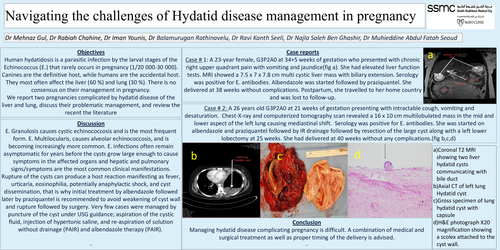
Case # 1: A 23-year female, G3P2A0 at 34+5 weeks of gestation who presented with chronic right upper quadrant pain with vomiting and jaundice. She had elevated liver function tests. MRI showed a 7.5 x 7 x 7.8 cm multi cystic liver mass with biliary extension. Serology was positive for E. antibodies. Albendazole was started followed by Praziquantel. She delivered at 38 weeks without complications. Postpartum, she travelled to her home country and was lost to follow-up.
Case # 2: A 26 years old G3P2A0 at 21 weeks of gestation presenting with intractable cough, vomiting and desaturation. Chest-X-ray and computerized tomography scan revealed a 16 x 10 cm multilobulated mass in the mid and lower aspect of the left lung causing mediastinal shift. Serology was positive for E. antibodies. She was started on albendazole and praziquantel followed by IR drainage followed by resection of the large cyst along with a left lower lobectomy at 25 weeks. She had delivered at 40 weeks without any complications.
Discussion
E. Granulosis causes cystic echinococcosis and is the most frequent form. E. Multilocularis, causes alveolar echinococcosis, and is becoming increasingly more common. E. infections often remain asymptomatic for years before the cysts grow large enough to cause symptoms in the affected organs and hepatic and pulmonary signs/symptoms are the most common clinical manifestations. Rupture of the cysts can produce a host reaction manifesting as fever, urticaria, eosinophilia, potentially anaphylactic shock, and cyst dissemination, that is why initial treatment by albendazole followed later by Praziquantel is recommended to avoid weakening of cyst wall and rupture followed by surgery. Very few cases were managed by Puncture of the cyst under USG guidance; aspiration of the cystic fluid, Injection of hypertonic saline, and re-aspiration of solution without drainage (PAIR) and albendazole therapy (PAIR).
Conclusion
Managing hydatid disease complicating pregnancy is difficult. A combination of medical and surgical treatment as well as proper timing of the delivery is advised.